

Industrial environments are becoming more connected, mobile and automated. AMRs, AGVs, robotics, Edge AI applications and other connected systems increasingly depend on wireless networks that can handle higher data volumes while maintaining reliable connectivity. This is creating demand for industrial Wi-Fi 7 solutions designed specifically for demanding operational environments.
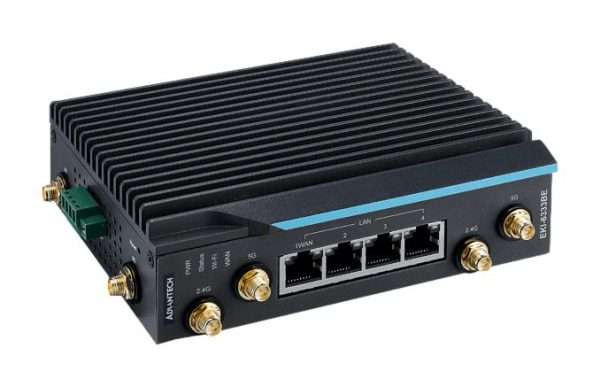
Advantech, which is a global leader in edge computing and IoT automation has responded with the EKI-6333BE-4GD, its first industrial-grade Wi-Fi 7 access point. Designed specifically for demanding industrial environments, it brings the latest Wi-Fi 7 capabilities into a form factor built for factory floors, logistics facilities, ports, and energy infrastructure.
For manufacturers, warehouses, logistics operators and other industrial organizations in the Middle East, the EKI-6333BE-4GD provides a platform for building high-performance wireless infrastructure around increasingly demanding applications.
Why Industrial Networks Are Under Pressure
Industrial wireless networks face very different requirements from normal office networks. Several converging forces are pushing conventional wireless infrastructure toward its limits like:
Mobile Robotics: AMRs and AGVs
Autonomous Mobile Robots (AMRs) and Automated Guided Vehicles (AGVs) require continuous, low-latency wireless connectivity as they navigate factory floors and warehouses.
Unlike static machinery, mobile robots roam across multiple access point cells, demanding seamless handoff without packet loss or latency spikes that could cause a collision, a missed pick, or an emergency stop. A single vehicle might cross dozens of cell boundaries per shift.
Edge AI: Data-Intensive Distributed Processing
Edge AI nodes which process camera feeds for quality inspection, anomaly detection, or predictive maintenance generate and consume substantial wireless bandwidth.
As AI models become more capable and deployments scale from pilot to production, the aggregate wireless data load from distributed edge processing grows rapidly. These workloads are latency-sensitive and cannot tolerate retransmissions.
Industrial IoT at Scale
Sensor density on modern factory floors is increasing. Condition monitoring, environmental sensing, process telemetry, and asset tracking collectively add hundreds of wireless endpoints per facility.
In environments where multiple IoT platforms coexist, spectrum congestion in the 2.4 GHz and 5 GHz bands becomes a real constraint on performance and reliability.
Why Standard Office Wi-Fi Doesn’t Work
An ordinary office Wi-Fi deployment cannot withstand these pressures. Office networks prioritize total throughput for static users, whereas industrial wireless connectivity demands deterministic low latency, continuous coverage across physical obstacles, high connection resilience, and immunity to electrical noise and wide temperature swings.
Also Read: E2C Trinity: Connecting Industrial Connectivity, Edge Computing and Operational Software
What Makes Wi-Fi 7 Relevant to Industrial Applications?
Wi-Fi 7 introduces capabilities that can be valuable in demanding wireless environments.
One important feature is support for the 6 GHz band. Additional spectrum can provide more capacity and help address congestion where numerous wireless devices operate in the same environment.
The EKI-6333BE-4GD supports 2.4 GHz, 5 GHz and 6 GHz connectivity, giving industrial networks access to tri-band Wi-Fi 7 capabilities. Advantech specifically highlights the 6 GHz band as a cleaner spectrum option for industrial connectivity.
Another key feature is Multi-Link Operation (MLO). MLO enables compatible Wi-Fi 7 devices to use multiple wireless links, which can contribute to more resilient connectivity and better handling of changing wireless conditions.
The EKI-6333BE-4GD also supports preamble puncturing, a Wi-Fi 7 capability highlighted by Advantech for congested environments.
The benefit of industrial Wi-Fi 7 is therefore not simply higher theoretical throughput. Additional spectrum, capacity and connectivity features can help address the practical challenges created by wireless congestion, mobile assets and increasingly data-intensive applications.
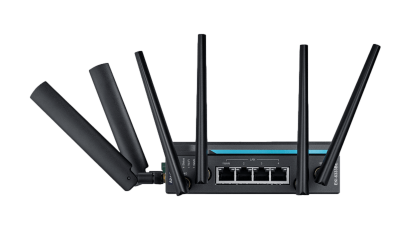
Introducing the Advantech EKI-6333BE-4GD
The EKI-6333BE-4GD is Advantech’s first industrial-grade Wi-Fi 7 access point, designed to deliver deterministic wireless connectivity for next-generation smart factories, autonomous logistics, and AI-driven industrial environments.
It is the first product in Advantech’s lineup to combine tri-band Wi-Fi 7 with industrial-grade hardware design and integrated network management which is purpose-built for the connectivity demands of modern industrial operations.
Its key specifications include:
| Radio & Wireless | |
| Wi-Fi Standard | IEEE 802.11be (Wi-Fi 7), backward compatible 802.11a/b/g/n/ac/ax |
| Frequency Bands | Tri-band: 2.4 GHz / 5 GHz / 6 GHz |
| Maximum Throughput | Up to 5.8 Gbps aggregate |
| MIMO | 2×2×2 MU-MIMO (one spatial stream per band) |
| Multi-Link Operation | Tri-band MLO — simultaneous operation across all three bands |
| Preamble Puncturing | Supported — for congested spectrum environments |
| Security | WPA3, WPA2/WPA3 Personal, WPA2/WPA3 Enterprise, OWE |
| Hardware & Industrial Design | |
| Enclosure | Rugged metal with passive heat dissipation (fanless design) |
| Operating Temperature | −40°C to +75°C |
| Storage Temperature | −40°C to +85°C |
| Power Input | Dual 12–48 VDC inputs for redundancy |
| Antennas | 6× external SMA-connector antennas (2 per band) |
| Mounting | DIN rail, wall mount |
| Dimensions | Approx. 99 × 107.5 × 43 mm |
| Network Management | |
| Integrated NMS | Centralized network management with topology view, device status, anomaly alerts, and OTA firmware updates |
| Management Protocols | SNMP (encrypted), SSH, CLI, web UI |
| Network Mode | Infrastructure / Access Point / Client mode |
| Security & Compliance | |
| Cybersecurity Standard | IEC 62443 compliant |
| Radio Certification | CE RED compliant |
| Encryption | WPA3 + encrypted SNMP |
| Ethernet | |
| Ports | 4× RJ45, 10/100/1000 Mbps |
The industrial design is particularly relevant for environments where temperature and operational conditions can differ significantly from a standard office. The dual power input also supports the product’s positioning for industrial applications.
Meanwhile, integrated network management provides centralized visibility for organizations operating larger wireless deployments.
How Wi-Fi 7 Supports Mobile Industrial Operations
The EKI-6333BE-4GD’s capabilities map directly onto the connectivity demands of the four most data-intensive and mobility-dependent application categories in modern industrial facilities.
AMRs and AGVs: Seamless Roaming at Scale
AMRs and AGVs depend on uninterrupted wireless connectivity for navigation, fleet coordination, obstacle detection, and remote supervision. The consequence of a wireless dropout is an emergency stop, a collision risk, or a halt in material flow that cascades through the production schedule.
The EKI-6333BE-4GD addresses this through tri-band MLO: a vehicle moving through the facility maintains simultaneous connections on multiple bands.
When it crosses a cell boundary, the handoff occurs on one band while data continues to flow on the others effectively eliminating the dead zone between access points.
Self-Healing Mesh technology further adds automatic rerouting around failed nodes, maintaining connectivity across large industrial sites without manual intervention.
Robotics: Low-Latency Coordination
Collaborative robots, robot arms, and multi-robot coordination systems require low, consistent latency for reliable operation.
A cobot receiving positional commands from a central controller cannot accommodate variable wireless latency without either slowing down to build in tolerance or risking positioning errors. Wi-Fi 7’s deterministic connectivity enabled by MLO and improved scheduling provides the consistent low-latency channel these applications require.
The EKI-6333BE-4GD’s 6 GHz band access also helps here: high-bandwidth, low-interference channels reduce the queuing delays that cause latency spikes in congested 5 GHz environments.
Edge AI: High-Throughput Data Feeds
Edge AI nodes like camera-based quality inspection systems, AI-enabled condition monitoring platforms, and intelligent video analytics generate substantial data that must flow between the edge device, a local aggregation point, and potentially a cloud or on-premise AI platform. As factories deploy more edge AI nodes, the aggregate wireless load grows proportionally.
With up to 5.8 Gbps aggregate throughput and MU-MIMO support for multiple simultaneous high-bandwidth streams, the EKI-6333BE-4GD can handle the wireless load from multiple edge AI nodes without degrading to a first-come-first-served queue that reintroduces the latency variability these applications cannot tolerate.
XR and Remote Operations: High-Bandwidth, Low-Latency Workflows
Extended reality (XR) headsets for remote assistance, augmented reality guidance for maintenance procedures, and remote operation stations for hazardous environments all require both high bandwidth (for video streaming) and low latency (for real-time interaction).
These are among the most demanding wireless use cases in industrial environments and the ones that most visibly fail when the wireless network cannot sustain the required quality of service.
The EKI-6333BE-4GD’s tri-band MLO enables XR devices to maintain stable, high-bandwidth connections while moving through a facility, eliminating the degradation in experience that occurs as devices transition between access point cells on conventional single-band connections.
Managing Industrial Wireless Networks at Scale
Deploying dozens or hundreds of wireless access points across a large facility can create management complexity. The Advantech EKI-6333BE-4GD includes integrated software tools designed to streamline operation and monitoring for network engineers and IT/OT administrators.
Network Topology View
The integrated NMS provides a visual topology of the entire wireless network like which access points are active, how they connect, and where coverage zones overlap. This gives network administrators a live view of the infrastructure without on-site surveys or manual documentation.
Device Status and Anomaly Alerts
Real-time device status monitoring with automatic anomaly detection and alerting. When an access point’s performance degrades, a connected device drops unexpectedly, or an RF condition changes, the NMS surfaces an alert before the issue causes operational impact.
OTA Firmware Updates
Over-the-air firmware updates can be pushed centrally to all access points in the network simultaneously or scheduled to roll out sequentially to avoid disruption. In a large deployment, this is the difference between a maintenance task that takes minutes and one that takes days of site visits.
IEC 62443 and CE RED Security Compliance
The EKI-6333BE-4GD is designed to meet IEC 62443 which is the industrial cybersecurity standard governing OT/ICS network security and CE RED for radio equipment regulatory compliance.
WPA3 encryption and encrypted SNMP are supported, ensuring that the wireless infrastructure itself does not become an attack surface in environments where cybersecurity is a regulatory and operational requirement.
This is a specific concern in UAE and GCC critical infrastructure where ADNOC, DEWA, and port operators all operate under frameworks that require defensible cybersecurity postures at every network layer.
Where Industrial Wi-Fi 7 Fits in the Middle East
Industrial deployments across the Middle East present demanding environmental and operational challenges like high ambient operating temperatures, dust accumulation, expansive outdoor-to-indoor facilities, and strict regulatory standards for critical infrastructure cybersecurity.
The UAE and GCC are among the most active regions globally for industrial automation investment, smart infrastructure deployment, and Industry 4.0 adoption. Several sectors have specific characteristics that make industrial Wi-Fi 7 particularly relevant such as:
| Sector | Wireless Challenge | Wi-Fi 7 Advantage |
| UAE Manufacturing & Smart Factories | AMR fleets, edge AI quality inspection, machine monitoring | MLO for seamless roaming; 6 GHz for clean spectrum away from congested bands |
| Logistics & Warehousing | High-bay AGV operations, dense scanner populations, real-time WMS integration | 5.8 Gbps throughput; MU-MIMO for dense device environments |
| Ports & Terminals | Crane automation, vehicle tracking, container yard operations in harsh outdoor environments | −40°C to +75°C operating range; rugged metal enclosure; dual power input |
| Airports | Baggage handling automation, airside vehicle management, gate equipment | Deterministic low-latency connectivity; IEC 62443 compliance for secure airside networks |
| Oil & Gas Facilities | Remote operations, XR-assisted maintenance, inspection drone coordination | Rugged design; dual power redundancy; IEC 62443 cybersecurity for OT environments |
| Utilities & Smart Infrastructure | SCADA wireless backhaul, AMI, substation automation | Industrial-grade reliability; centralized NMS management across distributed sites |
| Smart Manufacturing (KSA, Qatar) | Vision 2030 industrial automation, high-density robotic assembly | Scalable Wi-Fi 7 infrastructure; integrated NMS for multi-site fleet management |
When Should a Business Consider Industrial Wi-Fi 7?
Wi-Fi 7 represents a step-change in wireless technology, but network upgrades should be aligned with specific operational requirements. Wi-Fi 7 becomes strategically relevant when one or more of the following conditions apply such as:
- High wireless data loads: Edge AI, video analytics, or large file transfer workloads are approaching or saturating current access point capacity
- Dense wireless environments: High device counts per access point are causing throughput degradation or increased latency, particularly in the 2.4 GHz and 5 GHz bands
- Mobile assets with roaming requirements: AMRs, AGVs, forklifts, or other mobile equipment are experiencing connectivity gaps or control latency during cell transitions
- Spectrum congestion: Interference from neighbouring networks, legacy devices, or industrial equipment is reducing reliability in existing Wi-Fi deployments
- Increasing automation ambitions: The facility is planning to add AMRs, robotics, edge AI, or XR-based operations that will introduce new wireless load and roaming requirements
- New facility or infrastructure refresh: Planning a greenfield deployment or major network refresh specifying Wi-Fi 7 from the outset avoids a near-term upgrade cycle
For static, low-bandwidth telemetry sensors (e.g., occasional temperature readings from stationary tanks), existing industrial Wi-Fi 5/6 or cellular gateways may remain sufficient until broad infrastructure upgrades take place.
Why Choose Amplicon Middle East?
Amplicon Middle East is an authorised Advantech distribution partner for the UAE and GCC, with a portfolio spanning industrial computing, edge AI, networking, and IoT infrastructure.
Amplicon Middle East brings decades of expertise in critical OT infrastructure:
- Industrial Networking Expertise: Deep domain knowledge in designing resilient, interference-free wireless architectures for harsh environments.
- End-to-End Product Selection: Access to the complete portfolio of Advantech industrial computing, gateways, and networking equipment.
- System Architecture & Integration Consulting: Site surveys, RF heat mapping, band planning, and cybersecurity validation tailored to Middle Eastern industrial operations.
- Local Regional Support: On-the-ground technical advice, project consultation, and responsive post-deployment service across the UAE, Saudi Arabia, and the GCC.
For organizations planning industrial Wi-Fi UAE deployments or broader industrial networking projects across the GCC, specialist guidance can help decide whether Wi-Fi 7 is appropriate and how the access point should fit into the wider network architecture.
FAQ: Industrial Wi-Fi 7 in the Middle East
What is industrial Wi-Fi 7?
Industrial Wi-Fi 7 is Wi-Fi 7 technology designed or deployed for demanding industrial environments where applications may require greater capacity, mobility, connection resilience and congestion management.
What is the Advantech EKI-6333BE-4GD?
It is an industrial-grade Wi-Fi 7 access point supporting 2.4 GHz, 5 GHz and 6 GHz bands, up to 5.8 Gbps throughput, tri-band MLO and 2×2×2 MU-MIMO.
Why is 6 GHz important for industrial Wi-Fi?
The 6 GHz band provides additional spectrum for compatible devices. It is a cleaner spectrum option that can help address congestion.
What is Multi-Link Operation?
MLO is a Wi-Fi 7 capability that allows compatible devices to use multiple wireless links, potentially improving connection resilience and network performance.
Can Wi-Fi 7 support AMRs and AGVs?
Yes. Wi-Fi 7 can form part of the wireless infrastructure supporting AMRs and AGVs. Actual performance depends on network design, coverage, roaming, interference and application requirements.
Is the EKI-6333BE-4GD suitable for harsh industrial environments?
Yes, it has an operating temperature range of -40°C to 75°C, dual power input and an industrial-grade design.
When should a factory upgrade to Wi-Fi 7?
Factories should consider Wi-Fi 7 when wireless data requirements, device density, mobility, congestion or automation demands are increasing and existing infrastructure may not provide the required capabilities.
Ready to Upgrade Your Industrial Wireless Infrastructure in the GCC?
Whether you are expanding an AMR fleet in a UAE logistics facility, implementing real-time Edge AI vision lines, or designing a smart factory in the GCC, the Advantech EKI-6333BE-4GD delivers the deterministic performance and industrial reliability your operations require.
Planning an industrial wireless network in the UAE or GCC?


