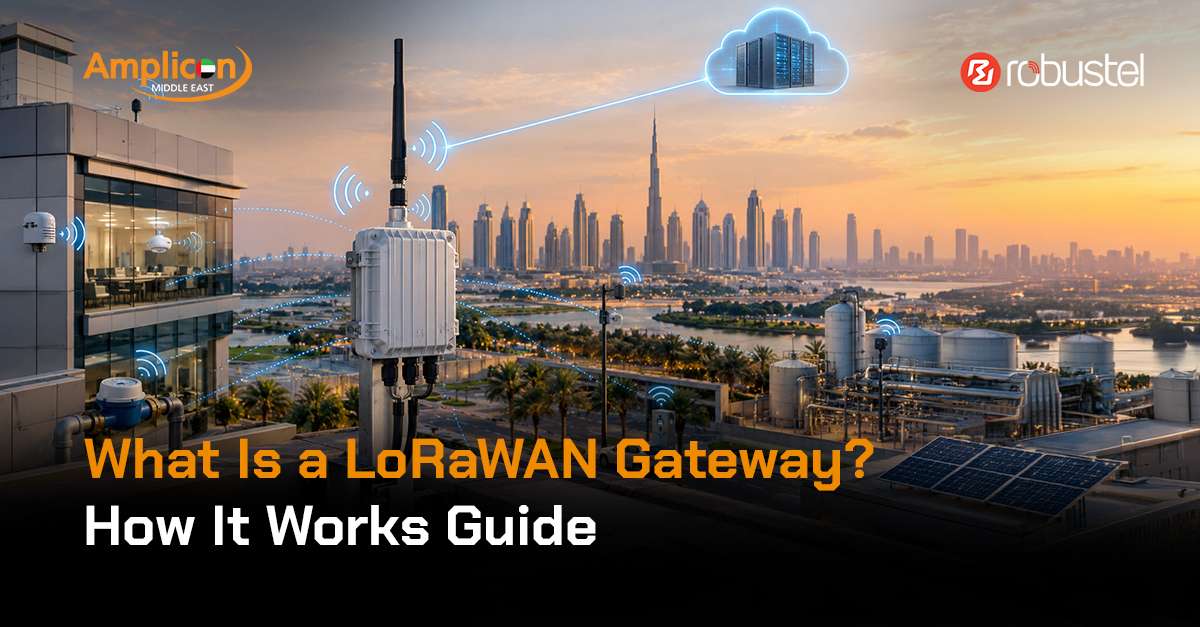
A LoRaWAN gateway is a radio receiver and transparent communication bridge that receives wireless data packets transmitted over sub-gigahertz radio frequencies from long-range sensors and forwards them over an IP network (Ethernet, Wi-Fi, or cellular) to a centralized LoRaWAN Network Server (LNS).
The gateway is the bridge between the low-power wireless LoRa radio network and the IP-connected world. It listens on multiple LoRa channels simultaneously, receives uplink transmissions from end devices (sensors, meters, trackers), and passes them upstream. It also relays downlink messages from the network server back to end devices for configuration commands, acknowledgements, or control signals.
How Does a LoRaWAN Gateway Work?
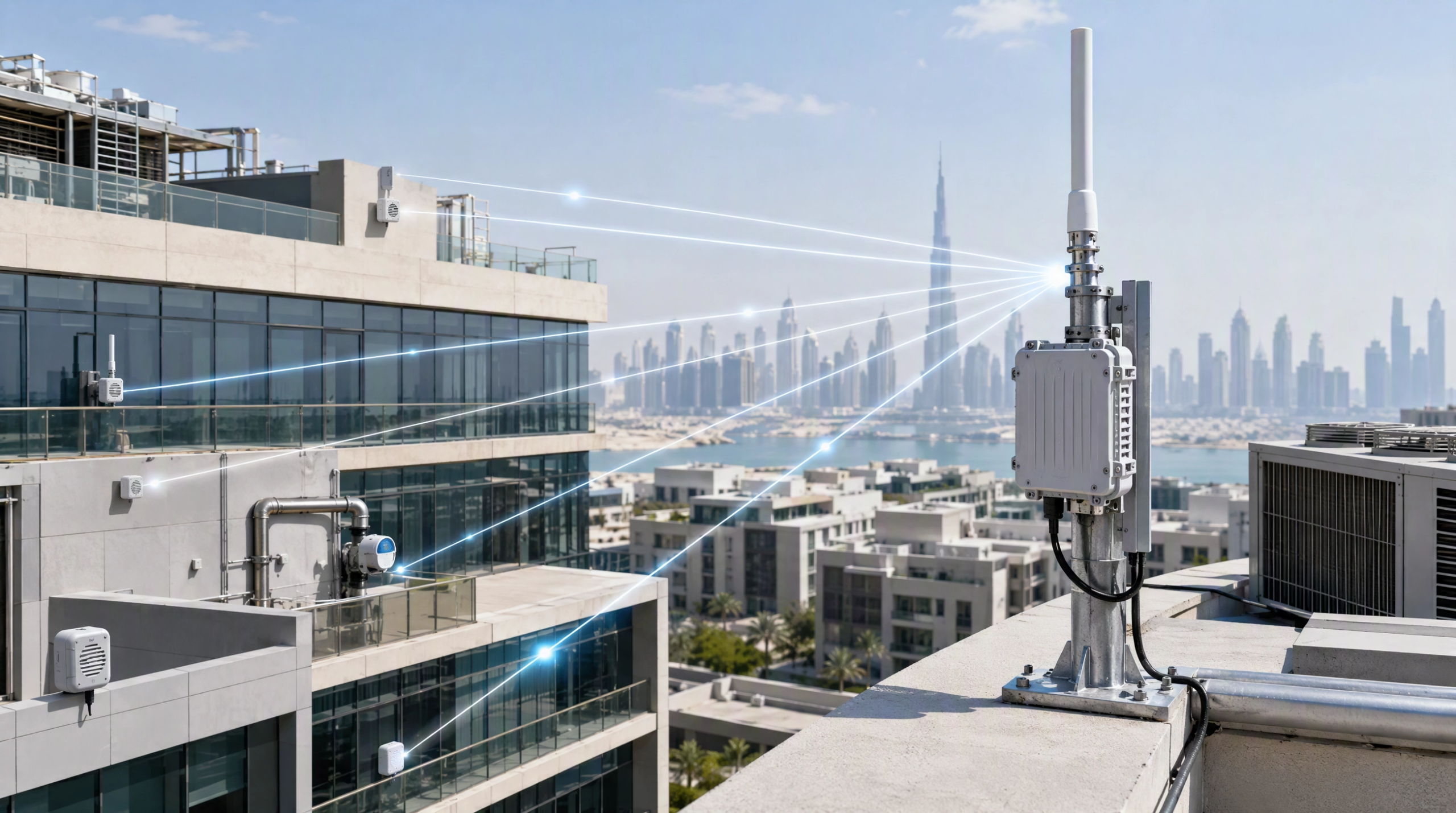
A LoRaWAN gateway acts as a transparent bridge between low-power IoT end-devices and a centralized cloud network server. It captures radio frequency packets sent via long-range LoRa modulation and converts them into standard IP data, forwarding them via cellular, Wi-Fi, or Ethernet backhaul. Here’s how it works:
Star-of-Stars Network Topology
Unlike mesh networks (such as Zigbee or Thread), where sensors hop data from one node to another, LoRaWAN uses a star-of-stars topology. Every sensor node in the field transmits its packet directly over the air without routing through adjacent sensors.
Any LoRaWAN gateway within radio range that receives the transmission will capture the packet simultaneously. The gateways do not process or store the sensor data; instead, they wrap the raw radio packet in an IP wrapper such as UDP or MQTT and push it upstream to the network server.
Uplink and Downlink Communications
Uplink: The most common data path in IoT networks. A sensor wakes up, measures telemetry (e.g., room temperature or water meter pulse), converts the measurement into an encrypted payload, and broadcasts an uplink radio signal.
Downlink: Sent when an application needs to send instructions back to an end-device (e.g., closing a water valve or adjusting a thermostatic valve). The network server selects the single gateway that received the strongest uplink signal from that sensor and routes the downlink command back through it during specific listening windows.
Physical Layer (PHY) Relay Security
Standard LoRaWAN gateways operate strictly at the Physical Layer of the OSI model. Gateways do not possess the cryptographic security keys required to decrypt sensor data.
Even if an attacker gains physical possession of a gateway, they cannot read the payload contents inside the transmissions. Payload decryption occurs exclusively at the destination either inside the LoRaWAN Network Server or on the end-application server.
Also Read: Robustel LoRaWAN Gateway Portfolio: How to Choose the Right Gateway
Where the Gateway Sits in LoRaWAN Architecture
LoRaWAN defines a four-layer architecture. Understanding each layer clarifies why the gateway is defined the way it is and what it does not do:
| Layer | Component | Function |
| Physical | End devices | Sensors, meters, and trackers that measure and transmit LoRa radio packets. Battery-powered, long-life. Communicate only with gateways. |
| Access | Gateway | Receives LoRa radio packets from end devices. Forwards them over IP to the LNS. Transmits downlinks on behalf of the LNS. Holds no device keys; does not interpret payload data. |
| Network | LoRaWAN Network Server (LNS) | Manages device authentication (OTAA/ABP), deduplicates packets received by multiple gateways, handles MAC layer messaging, and routes payloads to the correct application server. |
| Application | Application server | Decrypts the application payload, interprets sensor data, triggers alerts, feeds dashboards, and interfaces with business systems (BMS, SCADA, ERP, cloud platforms). |
What Is a LoRaWAN Network Server?
The LoRaWAN Network Server is the central intelligence of the entire network topology. While gateways simply capture radio packets, the LNS performs critical management functions such as:
- Packet De-duplication: Because multiple gateways frequently receive the same uplink transmission from a single sensor, the LNS filters out duplicate packets and presents a single clean payload to the application layer.
- Device Authentication & Key Management: The LNS validates device credentials during network join requests and manages encryption keys.
- Adaptive Data Rate (ADR): The LNS continuously monitors signal quality (RSSI and SNR) and instructs sensors to lower their transmit power or increase data rates when close to a gateway, significantly extending sensor battery life.
Types of LoRaWAN Gateways
LoRaWAN gateways differ across two main dimensions: physical form factor, and capability level. Here are the types of LoRaWAN gateways:
Indoor vs Outdoor Gateways
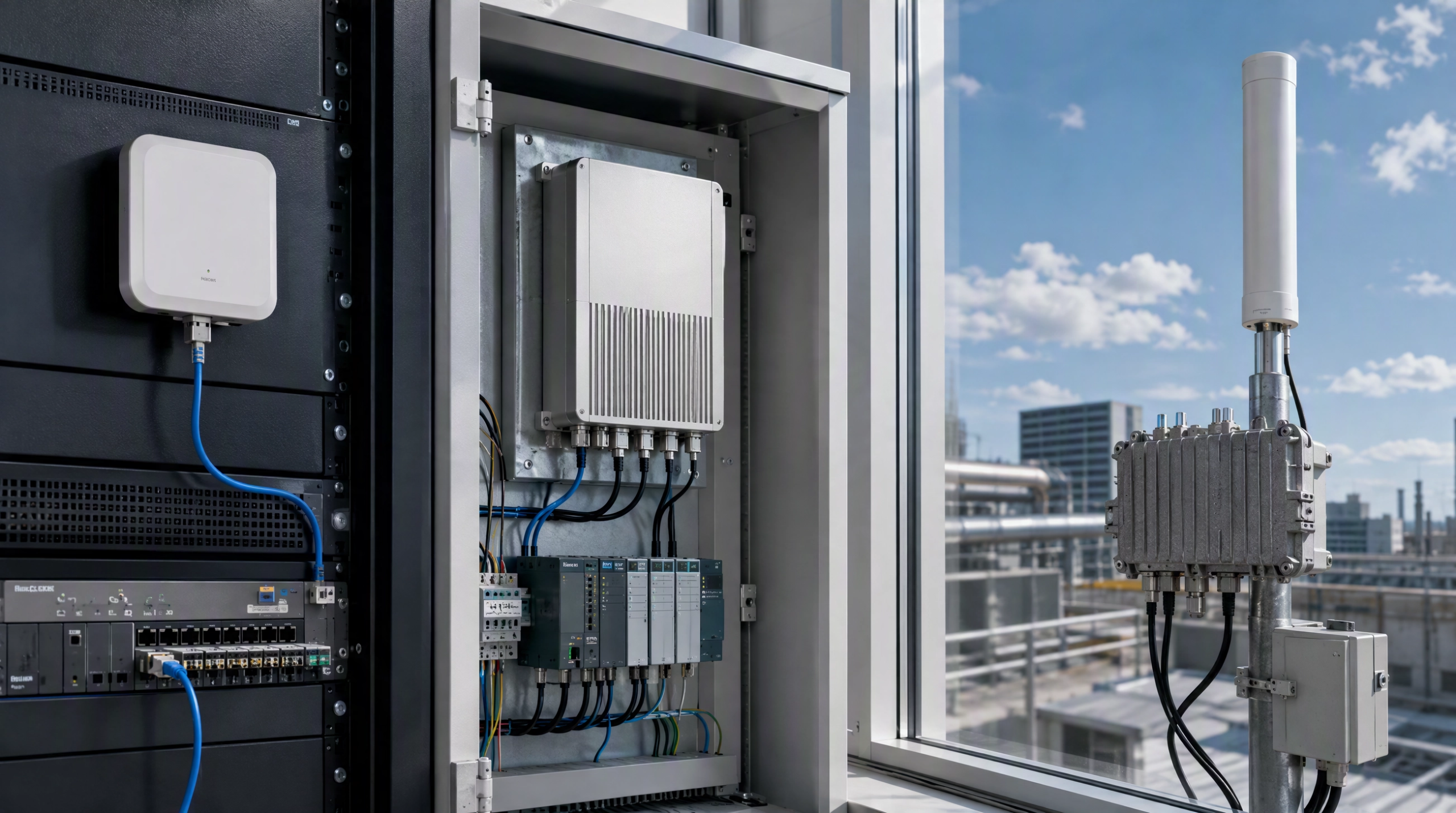
Form factor is determined by deployment environment:
Indoor gateways are designed for installation in building comms rooms, server racks, or wall-mounting in protected spaces. They have standard plastic or metal enclosures, internal or omni antennas, and Ethernet plus Wi-Fi backhaul. Compact form factors suit dense building environments.
Outdoor gateways are built for pole-mounting, rooftop installation, or enclosure in street furniture. They carry IP67 or IP65 weatherproof ratings, reinforced external antenna connectors (N-type or RP-SMA), and cellular (4G/LTE) backhaul as standard. Temperature ranges extend to cover full outdoor exposure usually −40°C to +70°C.
Some industrial gateways including models in the Robustel range can be converted between indoor and outdoor use via an IP67 enclosure accessory, giving project flexibility without replacing the core hardware.
The Capability Ladder: Three Gateway Types
Beyond form factor, gateways vary in how much intelligence they carry:
- Packet forwarder gateway: Receives LoRa packets and forwards them to an external, cloud-hosted LNS via Semtech UDP or BasicStation. No local intelligence, no built-in LNS. Right choice when a cloud LNS is already in place and cost-effective coverage is the primary requirement.
- Gateway with built-in LNS: Runs an embedded LoRaWAN Network Server (typically ChirpStack) locally on the gateway hardware. The network can operate independently of cloud connectivity where devices join, uplinks are processed, and downlinks are scheduled entirely on-device. Adds per-site cost but removes cloud dependency and latency.
- Edge gateway: Adds compute capability beyond LNS functions which are protocol bridging (LoRaWAN to BACnet, Modbus, KNX, M-Bus), local rule execution, alarm handling, AI inference, and integration with building or industrial automation systems. The most capable class, used where data must be acted on locally rather than simply forwarded.
Hardware Specifications to Look for
When evaluating hardware for an enterprise deployment, system integrators should focus on six core hardware specifications:
| Specification | Typical Value | Why It Matters |
| Channels | 8 (standard) | Number of simultaneous LoRa channels the gateway can receive. 8 is the LoRaWAN standard for full-featured gateways; single-channel gateways exist but are not LoRaWAN-compliant. |
| TX power | +27 dBm (max) | Maximum downlink transmit power. Higher power improves downlink range and reliability to devices at the edge of coverage. |
| RX sensitivity | −137 to −141 dBm | The weakest signal the gateway can decode. Higher sensitivity (more negative number) means greater range and better penetration through building materials. |
| Node capacity | Up to 2,000 | Maximum end devices per gateway per the LoRaWAN standard. Practical limits depend on transmission frequency and duty cycle of end devices. |
| Range: line of sight | ~10 km | Typical outdoor, open-terrain range. Varies significantly with terrain, antenna height, and environmental conditions. |
| Range: NLoS/buildings | ~5 floors/6 walls | Empirical indoor penetration. A single indoor gateway often covers an entire mid-rise commercial building. |
| Frequency plans | EU868, US915, AS923, AU915 | Regional frequency allocations. In the UAE and Middle East, AS923 (923 MHz) and EU868 (868 MHz) are the most common deployments. Confirm carrier and regulatory requirements before specifying. |
Common LoRaWAN Gateway Use Cases
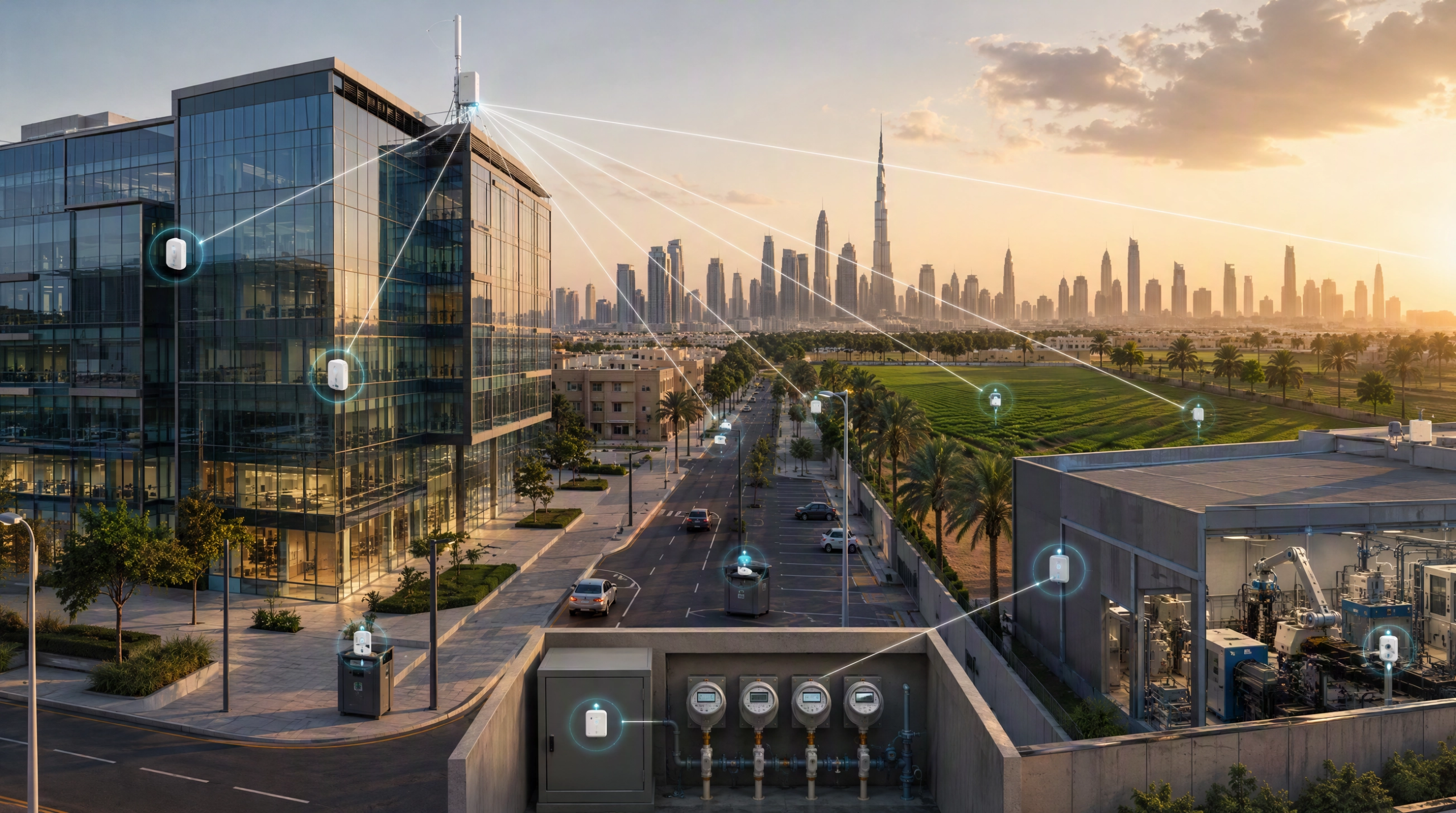
LoRaWAN gateways are deployed wherever long-range, low-power wireless sensor connectivity is needed. The most common applications:
Smart Buildings
Indoor air quality, temperature, occupancy, leak detection, and wireless sub-metering across commercial office, retail, and mixed-use buildings. A single gateway can cover an entire mid-rise building.
Utilities & Metering
Automated Meter Infrastructure (AMI) for electricity, water, and gas distribution networks. LoRaWAN enables large-scale meter reading across city districts with one or a few gateways, replacing manual reads or expensive cellular-per-meter approaches.
Smart Cities
Street lighting control, parking sensors, waste bin fill-level monitoring, environmental quality stations, and traffic flow sensing across municipal infrastructure. City-scale LoRaWAN networks typically use a small number of high-mounted outdoor gateways to cover large geographic areas.
Also Read: LoRaWAN for Smart Buildings: Wireless Sub-Metering & BMS Integration Without Rewiring
Agriculture & Remote Monitoring
Soil moisture, crop canopy temperature, irrigation control, tank level, and livestock tracking across large agricultural sites. LoRaWAN’s 10 km line-of-sight range at optimal conditions means a single gateway can serve hundreds of sensors across many hectares.
Industrial Monitoring
Machine condition monitoring (vibration, temperature), HVAC plant room sensing, compressed air leak detection, and environmental compliance monitoring in manufacturing and oil & gas sites. Industrial gateways add ruggedisation, serial I/O, and protocol bridging for integration with SCADA and plant automation systems.
FAQ: LoRaWAN Gateway Explained
What is the difference between LoRa and LoRaWAN?
LoRa (Long Range) is the physical radio modulation technology that converts digital data into chirp spread spectrum (CSS) radio signals. LoRaWAN (Long Range Wide Area Network) is the media access control (MAC) protocol layer that defines how devices communicate, authenticate, encrypt data, and format packets over the LoRa radio layer.
What is a LoRaWAN Network Server (LNS)?
A LoRaWAN Network Server is the core software engine responsible for managing the network topology. It receives packets forwarded by gateways, eliminates duplicate messages, authenticates end-devices, decrypts telemetry payloads, manages adaptive data rates, and routes downlink commands.
How far can a LoRaWAN gateway reach?
LoRaWAN gateway range varies significantly by environment. In open, line-of-sight optimal conditions (rural, rooftop-mounted, flat terrain), a single gateway reliably reaches up-to 10 km or more. In urban environments with buildings and obstructions, usual ranges are 2–5 km.
How many devices can a LoRaWAN gateway connect?
A standard 8-channel LoRaWAN gateway can theoretically support up to 2,000 end devices. The practical number depends on how frequently end devices transmit. A network of sensors that each transmit once every 10 minutes will support far more devices than one where sensors transmit every 30 seconds.
What is a LoRaWAN gateway used for?
A LoRaWAN gateway is a hardware device that acts as a bridge between smart sensors (end nodes) and a central cloud network server. It receives long-range radio signals from low-power devices and forwards that data to the internet using standard connections like Ethernet, Wi-Fi, or cellular.
Do I need a gateway for every LoRaWAN sensor?
No. Unlike Bluetooth or Wi-Fi, which require close proximity to a router, a single LoRaWAN gateway can collect data from hundreds or thousands of sensors spread across an entire building, university campus, or industrial complex.
Indoor or outdoor LoRaWAN gateway — which do I need?
If all your sensors are located inside a single office building, hotel, or warehouse, an indoor gateway is usually sufficient. If you need to cover an entire outdoor campus, agricultural fields, utility pipelines, or if the gateway must be mounted on an exposed rooftop, choose an outdoor IP67-rated gateway.
Is LoRaWAN better than Wi-Fi?
Neither LoRaWAN nor Wi-Fi is universally “better”. They serve entirely different purposes. LoRaWAN is better for long-range, battery-saving smart sensors sending tiny bits of data. Wi-Fi is better for short-range, high-speed internet and heavy data tasks like video streaming.
Can I use LoRa without LoRaWAN
Yes. You can use raw LoRa modulation to create point-to-point or custom star topology networks without using the LoRaWAN network protocol. This is common in basic DIY telemetry or proprietary long-range remote control setups. However, using raw LoRa lacks the standardized security (AES-128 encryption), automated device joining, payload de-duplication, and adaptive data rate (ADR) features natively built into LoRaWAN.
How much does a LoRaWAN gateway cost?
A LoRaWAN gateway generally costs anywhere from $70 to over $1,000, depending primarily on whether it is designed for indoor, outdoor, or heavy industrial use.
Choosing a Gateway & Next Steps
Understanding what a LoRaWAN gateway is and how it fits into your broader network architecture is the first step toward building a scalable IoT deployment. Get that decision right and the gateway becomes an invisible, reliable foundation for your IoT network. Get it wrong and you’re adding middleware, workarounds, and cost to fix a mismatch that should have been resolved at specification.
Amplicon Middle East supplies and supports the full Robustel LoRaWAN gateway range across the UAE and GCC, including models at every tier of the capability ladder. Our engineering team can help you choose the right gateway for your application, backhaul options, and integration architecture.
Contact Amplicon Middle East to discuss your LoRaWAN project.