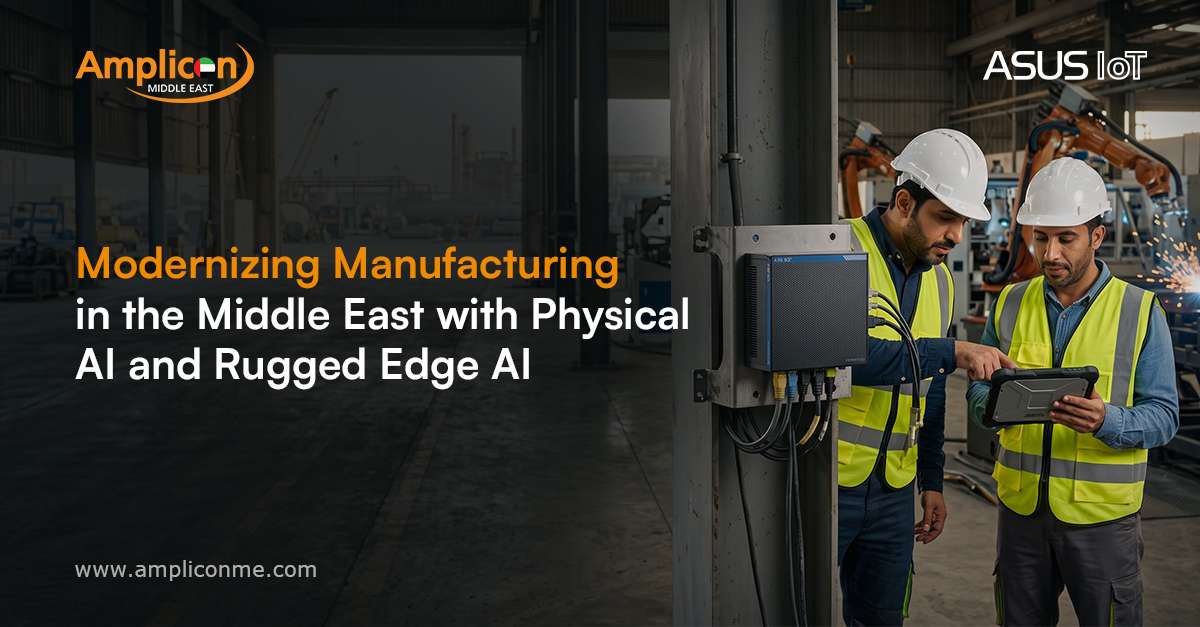
This is where Edge AI in manufacturing becomes a game changer. By processing data directly at the production line, Edge AI in manufacturing enables real-time inspection, predictive maintenance, and intelligent automation without the latency and reliability risks of centralized systems.
Manual inspection, rule-based vision systems, and reactive maintenance create bottlenecks in high-speed manufacturing lines. Missed surface defects, inconsistent machining quality, unplanned downtime, and rising scrap rates directly impact margins. At the same time, manufacturers face pressure to modernize operations and adopt smart factory practices aligned with initiatives across Saudi Arabia, the UAE, and the wider Middle East.
This is where Edge AI becomes a game changer. By processing data directly at the production line, edge AI enables real-time inspection, predictive maintenance, and intelligent automation without the latency and reliability risks of centralized systems. Rugged industrial products such as MIC-770 and MIC-730 deliver the compute power and durability required to deploy AI exactly where manufacturing decisions are made: on the factory floor.
Challenges in Electronics & Metal Manufacturing
Manufacturing electronics and heat sinks involves a high degree of complexity, merging precision metalwork with delicate component assembly. Several critical challenges currently hinder productivity in regional factories:
High Precision Requirements for Heat Sinks
Heat sinks rely on precise fin geometry and surface flatness to dissipate heat effectively. Even a minor burr, a microscopic crack, or a slight deviation in fin spacing can significantly reduce thermal performance, potentially leading to the failure of the final electronic device. Manual inspection of thousands of tiny fins is not only slow but prone to high error rates.
Assembly Complexity in PCBAs
Printed Circuit Board Assembly requires the placement of hundreds of tiny components. Traditional Automated Optical Inspection (AOI) systems often struggle with false calls flagging good boards as defective due to variations in component color, shadow, or minor solder reflections. This creates a bottleneck where human operators must re-verify every defect, slowing down the entire line.
Harsh Environmental Factors
In many GCC industrial zones, factories must contend with ambient heat and the particulate matter associated with metal machining and soldering. Standard computing equipment often fails in these environments due to dust ingress or thermal throttling, leading to system crashes that halt production lines.
Data Silos and Reactive Maintenance
Most traditional manufacturing setups are reactive. If a CNC machine cutting heat sinks goes out of alignment, the error is often only discovered during post-production QC, by which time a whole batch of material has been wasted. Without real-time data, predictive maintenance is impossible.
Also Read: Military Rugged Laptops & Tablets for Defense Edge Computing
AI-Powered Edge Computing in Production
The transition from traditional automation to Edge AI for factories addresses these challenges by bringing intelligence directly to the machine level.
Real-Time Visual Inspection with Advantech Edge AI in Manufacturing
Using AI vision inspection, systems can be trained to recognize the ideal state of a heat sink or a circuit board. Unlike rule-based systems, AI can distinguish between a harmless surface reflection and a genuine solder bridge or a structural crack in an aluminum fin. This drastically reduces false positives and ensures that only 100% compliant parts move to the next stage.
Predictive Maintenance for CNC and SMT Machines Advantech Edge AI in Manufacturing
By integrating an industrial AI edge computer with machine sensors (vibration, temperature, power draw), manufacturers can implement predictive maintenance. AI algorithms can detect the subtle changes in vibration that indicate a tool is becoming dull or a motor is about to fail. In the context of GCC manufacturing, this prevents the surprise downtimes that are particularly costly in high-volume electronics lines.
Autonomous Process Optimization Advantech Edge AI in Manufacturing
Edge AI doesn’t just find errors; it can prevent them. For example, if the AI detects a slight trend in component misalignment on an SMT (Surface Mount Technology) line, it can feed that information back to the placement machine to auto-calibrate its coordinates before a defect ever occurs.
Deploying MIC-770 & MIC-730 in the Middle East

The success of a smart factory solution depends heavily on the reliability of the underlying hardware. The MIC-770 and MIC-730 series are designed to be the brains of the modern electronics production line.
MIC-770: Centralized High-Performance Hub
The MIC-770 is engineered for compute-intensive workloads such as AI vision inspection and real-time analytics. Its rugged, fanless design supports continuous operation in metalworking and electronics facilities exposed to heat, dust, and vibration.
Key deployment roles include:
- AI-based surface inspection for heat sinks and machined components
- Vision-based assembly verification for electronics enclosures and modules
- Real-time analytics for process optimization
With support for advanced AI accelerators, the MIC-770 serves as a powerful edge AI computing device manufacturing platform capable of handling complex models without sacrificing speed or reliability.
MIC-730: Compact Edge Inference

For specific AI-heavy tasks like deep learning-based defect classification, the MIC-730 uses the NVIDIA Jetson architecture. Features include:
The MIC-730 is purpose-built for AI inference, offering high TOPS (Tera Operations Per Second) performance per watt. This is ideal for localized inspection stations where space and power efficiency are priorities.
Plus, its small size allows it to be mounted directly onto pick-and-place machines or heat sink extrusion lines, providing immediate intelligence at the point of manufacture.
Advantages for Middle East Manufacturers
The deployment of edge AI computing device manufacturing solutions offers specific strategic benefits for the GCC region including:
Achieving Global Quality Standards with Advantech Edge AI in Manufacturing
As GCC manufacturers aim to export electronics to European and American markets, they must meet stringent quality certifications. AI-driven inspection provides a digital audit trail and a level of precision that satisfies the most demanding international Tier-1 electronics brands.
Mitigating High Operational Costs with Advantech Edge AI in Manufacturing
While the Middle East is an attractive hub, the cost of specialized technical labor can be high. AI-driven automation allows factories to scale their output without a linear increase in headcount, optimizing the existing workforce for higher-level supervisory and maintenance roles.
Sustainability and Waste Reduction with Advantech Edge AI in Manufacturing
Sustainability is a key pillar of regional industrial visions. By reducing scrap rates in heat sink production and avoiding the processing of defective PCBAs, manufacturers significantly reduce their material and energy waste. AI ensures that every kilowatt of power and every kilogram of aluminum is used effectively.
Resilience to Ambient Conditions with Advantech Edge AI in Manufacturing
Hardware like the MIC-770 is built to withstand the unique climate of the Middle East. Its wide operating temperature range ensures that even if the factory floor hits 45°C during a summer afternoon, the AI inspection system continues to function without throttling or failure.
Also Read: Advancing Edge AI Vision in the Middle East As An Advantech Partner
Amplicon Middle East: Localizing the AI Revolution
Implementing AI in a manufacturing environment is not a plug-and-play task. It requires an understanding of both the software algorithms and the industrial environment. Amplicon Middle East works with manufacturers to design edge AI architectures aligned with specific production processes, inspection requirements, and environmental conditions.
From CNC machines and extrusion systems to robotic assembly cells, we ensure seamless integration of MIC-770 and MIC-730 platforms without disrupting ongoing operations. With regional engineering expertise, we validate system performance under real factory conditions, ensuring long-term reliability and stability.
Building Intelligent Electronics Manufacturing in the GCC
The electronics and heat sink manufacturing sector in the GCC is at a crossroads. To compete globally, regional players must move beyond traditional automation and embrace the intelligence of the edge.
By moving intelligence from the cloud to the factory floor, manufacturers gain the real-time insights needed to achieve zero-defect production. With the localized expertise of Amplicon Middle East, the transition to a smart factory is not just a possibility, it is a strategic certainty.
Contact Amplicon Middle East to explore how Edge AI can redefine your manufacturing excellence.
FAQ: AI in Heat Sink and Electronics Manufacturing
Can AI inspection be retrofitted to existing electronics production lines?
Absolutely. One of the greatest advantages of the MIC-770 and MIC-730 is their compatibility with standard industrial protocols like Modbus and EtherCAT. They can be integrated into existing SMT lines or CNC stations as a non-intrusive layer of intelligence with Advantech Edge AI in Manufacturing.
How does AI handle different types of heat sink designs?
AI models are trained on data, not fixed rules. Once a model is trained on the general geometry of heat sinks, it can easily be fine-tuned for a new design in hours, whereas traditional vision systems would require a complete re-programming Advantech Edge AI in Manufacturing.
Is the initial investment in Edge AI hardware high?
While there is an upfront cost for industrial-grade hardware, the ROI is usually realized within 12–18 months through reduced scrap rates, the elimination of manual re-verification, and the prevention of catastrophic machine failures Advantech Edge AI in Manufacturing.
Does the MIC-770 require a clean-room environment?
While electronics assembly often happens in clean rooms, the MIC-770 is ruggedized and fanless, meaning it is perfectly at home in the dirtier parts of a factory, such as the metal extrusion or machining areas for heat sink production Advantech Edge AI in Manufacturing.