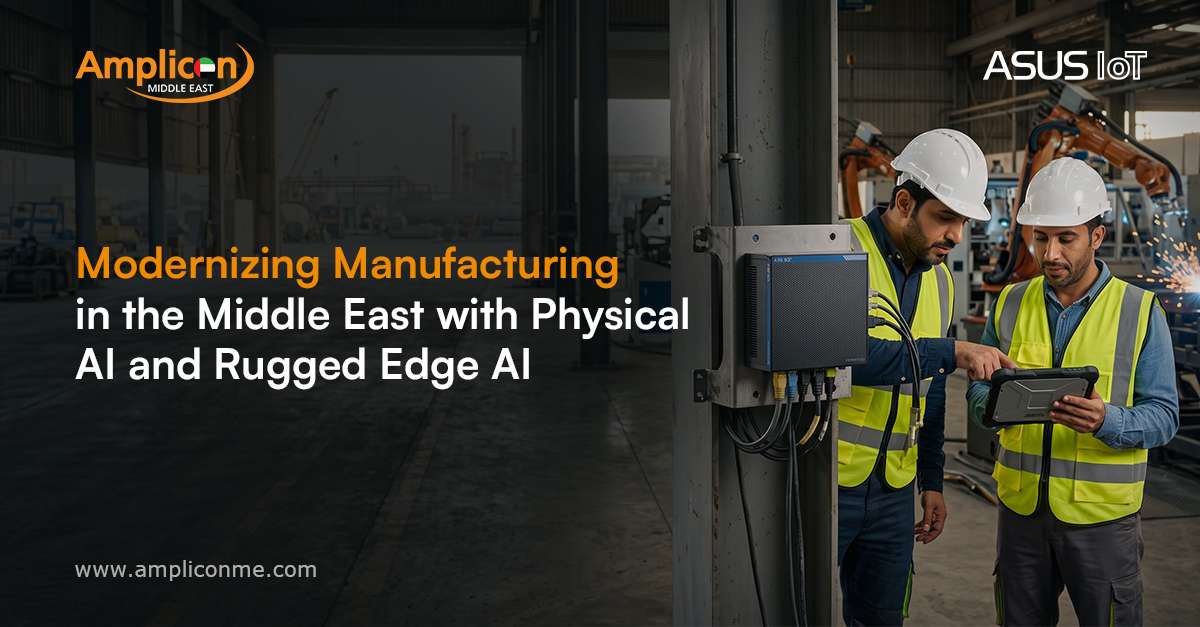
At the center of this transformation is ASUS IoT Edge AI, which places intelligence closer to machines, production lines, and logistics assets so organizations gain real-time visibility, faster response times, and measurable efficiency improvements. Among the platforms driving this shift, ASUS IoT Edge AI computers are designed specifically to improve productivity across industrial workflows.
At the center of this transformation is industrial IoT and edge computing. By placing intelligence closer to machines, production lines, and logistics assets, organizations gain real-time visibility, faster response times, and measurable efficiency improvements. Among the companies driving this shift is ASUS IoT, whose automation-focused hardware platforms are designed specifically to improve productivity across industrial workflows.
In this guide, let’s see how ASUS IoT automation productivity gains are achieved in practice from edge computing and real-time monitoring to scalable deployment in factories, warehouses, and logistics hubs across the Middle East.
What Is Industrial Automation and Why Productivity Matters
The Fundamentals of Automation
Industrial automation involves the use of control systems such as computers or robots and information technologies to handle different processes and machinery in an industry to replace a human being. It is the second step beyond mechanization in the scope of industrialization. In the modern context, this has evolved into “Cyber-Physical Systems,” where the physical world of the factory floor is mirrored and managed by a digital edge.
Productivity as the Core Automation Metric
Productivity in industrial environments is measured by how efficiently inputs (materials, energy, labor, time) are converted into outputs (finished products, throughput, quality). Even small improvements in cycle time, uptime, or defect reduction can result in significant financial gains.
For example:
- A 1% increase in uptime can translate into millions in additional annual output
- Faster cycle times reduce work-in-progress inventory
- Real-time quality monitoring minimizes scrap and rework
In a region where the cost of specialized technical labor and the need for rapid industrialization are high, ASUS IoT automation productivity is the key differentiator between a stagnant facility and a market leader.
Also Read: Edge AI in Factory Automation
ASUS IoT in the Middle East: Overview of Key Solutions for Automation
ASUS IoT is an ecosystem architect. Their enterprise offerings are designed to withstand the rigors of industrial environments while providing the computational power reserved for data centers.
ASUS IoT’s approach with the AIoT Partner Alliance Program aims to transform AI and IoT with a collaborative model. Focused on joint creation development, it combines hardware, AI software, design, and quality for complete market solutions. The ASUS AIoT Alliance Program unites industry partners for end-to-end AIoT solutions, providing benefits like training, project engagement, customer support, and marketing resources.
The PE2000U and PE2300U Series
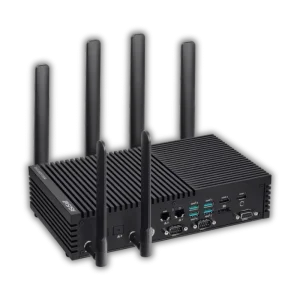
At the heart of the ASUS IoT portfolio is the PE series. The ASUS IoT PE2300U, for instance, is an Intelligent Edge Computer designed for AI-driven automation. Powered by 12th/13th Gen Intel Core processors, it handles intensive workloads such as multi-stream video analytics and real-time motion control with ease.
Enterprise-Grade Software & Management
ASUS IoT provides comprehensive tools like ASUS IoT Cloud Console for remote management. This allows systems integrators in the UAE and Saudi Arabia to monitor the health of hundreds of ASUS IoT devices across multiple geographic locations from a single dashboard, ensuring that the “Smart” in “Smart Factory” is manageable and secure.
Key Ways ASUS IoT Edge AI Enhances Productivity
Better Device Connectivity with ASUS IoT Edge AI
The primary hurdle in automation is protocol fragmentation. Machines on a factory floor often speak different languages. ASUS IoT devices act as universal translators. The PE2300U addresses this with rich I/O capabilities, featuring up to four COM ports, seven USB ports, and triple independent display ports. It is also ready for expansion with optional modules including PoE LAN, CAN-bus, and additional COM ports, ensuring it can act as a universal translator for any sensor or actuator.
Real-time Monitoring and Data Analytics ASUS IoT Edge AI
Productivity thrives on data. By deploying industrial IoT platforms based on ASUS hardware, manufacturers gain a granular view of their operations. The 11 TOPS NPU in the PE2300U allows for sophisticated analytics to be performed locally, enabling in-process quality control where the system detects a deviation in a product’s dimensions and adjusts the machine settings instantly, rather than waiting for a post-production batch check.
Scalable Edge Computing ASUS IoT Edge AI
Unlike cloud computing, which can suffer from latency issues, edge computing in manufacturing processes data right where it is generated. ASUS IoT edge servers achieve full CPU utilization through an efficient, fanless thermal solution, accommodating both high performance and silent operation in challenging environments.
Lower Maintenance Costs ASUS IoT Edge AI
The ruggedized nature of these devices ensures longevity. The PE2300U meets the military-grade MIL-STD 810H standard and supports wide temperatures ranging from -20°C to 60°C, along with a wide-range 9–36VDC-in. This extreme durability minimizes hardware failures and maintenance interventions.
Real-world Use Cases in Manufacturing and Logistics
AI-Powered Airport E-Gate Systems with ASUS IoT Edge AI
Modern airports in the Middle East are among the busiest in the world, requiring seamless passenger throughput without compromising security. ASUS IoT technology is a critical component in AI-powered Airport E-Gate systems. By deploying rugged edge computers at the gate, these systems can perform real-time facial recognition and biometric verification.
The edge architecture also improved security and privacy. Instead of transmitting sensitive biometric data across networks, only verification results (pass/fail) are communicated to central systems, reducing exposure of passenger information and ensuring compliance with privacy regulations.
Click here to read the complete guide on how we deployed AI-Powered Airport E-Gate Systems.
ASUS IoT Technologies That Drive Results
Industrial-Grade Edge Servers and Embedded Computers in the UAE, Saudi Arabia and Wider Middle East
You can’t have effective automation without a physical foundation built for the job. ASUS IoT’s PE2000U Series and complementary product families represent the culmination of decades of embedded systems engineering expertise. These computers feature:
- Rugged mechanical design with aluminum chassis and conformal coating for corrosion resistance
- Wide voltage input (9-36V DC) enabling direct connection to industrial power supplies without additional conversion
- Extensive I/O interfaces including multiple Gigabit Ethernet ports, USB 3.x, serial COM ports, and expansion slots for optional modules
- Active thermal management without cooling fans, eliminating vibration and acoustic noise while improving reliability
- Windows 11 IoT and Linux support providing flexibility in operating system selection and application development
This hardware foundation enables systems integrators to deploy complex IoT applications without worrying about whether the underlying platform will survive the manufacturing environment. Reliability translates directly into productivity which means less time spent troubleshooting hardware failures means more time optimizing processes.
AI and Machine Learning Acceleration
The integration of dedicated AI accelerators (NPU) in the latest ASUS IoT processors represents a watershed moment for edge automation. Traditional edge computers could run only lightweight AI models due to processor limitations. The 11 TOPS AI acceleration in the PE2300U enables deployment of sophisticated deep learning models directly on the edge computer.
This capability unlock enables advanced applications previously impractical at the edge like:
- Real-time defect detection using convolutional neural networks
- Anomaly detection in equipment sensor streams using recurrent neural networks
- Process optimization using reinforcement learning models
By running these models locally rather than sending data to cloud services, manufacturers achieve microsecond-level latency, privacy-compliant data processing, and reduced bandwidth consumption.
Seamless Integration with Existing Systems with ASUS IoT Edge AI
One of the greatest barriers to IoT adoption in manufacturing has always been integration complexity. Most factories operate heterogeneous equipment environments where different machines, sensors, and systems were installed in different eras using different communication protocols. ASUS IoT solutions address this integration challenge through multiple mechanisms.
The rich I/O capabilities of the PE2000U Series enable direct connection to legacy equipment using industrial protocols like Modbus, Profibus, CAN-bus, and proprietary RS-232/RS-485 connections.
Rather than requiring expensive protocol gateways, the edge computer can natively communicate with existing industrial infrastructure. This dramatically reduces integration costs and accelerates time-to-productivity for IoT deployments.
Plus, ASUS IoT computers support comprehensive industrial software ecosystems including OPC UA, MQTT messaging protocols, and standard industrial data formats. This interoperability ensures that ASUS IoT solutions fit naturally into existing manufacturing execution systems, ERP systems, and advanced analytics platforms.
Benefits for Decision Makers
For the Solution Architect or the CTO, the choice of ASUS IoT is driven by measurable metrics:
Faster Cycle Times
By optimizing the handshake between different machines on a production line, ASUS IoT Edge AI reduces the dead time between processes. This leads to faster cycle times and a direct increase in daily output.
Reduced Downtime
Through predictive maintenance algorithms running on rugged AI edge computers, facilities can move from “Fix it when it breaks” to “Fix it before it fails.” In high-stakes industries, this can save hundreds of thousands of dollars in lost production time.
Better Quality Control
AI-driven vision inspection, powered by ASUS hardware, provides a level of consistency that human inspectors cannot match. This ensures that only high-quality products leave the facility, reducing the risk of costly recalls and brand damage.
Better Cybersecurity at the Edge
Security is a major concern for GCC industrial leaders. By processing sensitive production data locally on rugged AI edge computers instead of transmitting it to a public cloud, manufacturers maintain a private data loop. ASUS IoT Edge AI devices also feature hardware-level security (TPM 2.0) to prevent unauthorized access to critical infrastructure.
ESG & Energy Efficiency
As part of regional sustainability goals, ASUS IoT Edge AI solutions are designed for high performance-per-watt. The efficient Intel Core Ultra processors and fanless thermal management reduce the overall energy footprint of the smart factory, helping manufacturers meet green building and environmental standards.
Reduced Total Cost of Ownership (TCO)
While industrial-grade hardware requires an initial investment, the long-term TCO is significantly lower than commercial alternatives. ASUS IoT’s guaranteed long-term availability (up to 7-15 years) means you won’t have to redesign your software stack every two years due to hardware obsolescence.
Also Read: Military Rugged Laptops & Tablets for Defense Edge Computing
ASUS IoT vs. Traditional Automation Tech
Modern Edge IoT vs. Legacy Systems
The distinction between modern edge computing approaches and traditional automation technology fundamentally reshapes what’s possible in manufacturing. Legacy systems like programmable logic controllers (PLCs), distributed control systems (DCS), and legacy SCADA systems were designed for a different era when data volumes were smaller, processing speeds didn’t matter as much, and connectivity was limited.
These legacy systems excel at direct equipment control and basic sequencing. They operate reliably for decades, which explains their continued prevalence on factory floors. However, they lack the intelligence, flexibility, and data-driven insight capabilities that modern manufacturing demands.
ASUS IoT solutions represent a complementary and increasingly dominant approach. Rather than replacing legacy systems entirely (a prohibitively expensive proposition for most organizations), modern edge IoT architectures layer intelligent services on top of existing infrastructure.
The legacy PLC continues executing real-time control logic, but ASUS IoT edge AI computers monitor the PLC’s behavior, detect patterns, predict failures, and optimize parameters. This hybrid approach captures the reliability and familiarity of legacy systems while adding modern intelligence.
Key Architectural Advantages
Several architectural advantages distinguish ASUS IoT Edge AI approaches from traditional automation like:
Latency and Responsiveness: Cloud-dependent IoT systems suffer from network latencies (100-500ms round-trip). ASUS IoT edge processing reduces latencies to 10-50ms, enabling applications requiring real-time responsiveness that cloud systems cannot support.
Data Privacy and Security: Manufacturing data often contains proprietary process information and intellectual property. Edge processing keeps sensitive data local rather than transmitting it to external cloud providers, addressing privacy and security concerns inherent in cloud architectures.
Reliability and Resilience: Cloud-dependent systems fail when internet connectivity drops. ASUS IoT edge computers continue operating independently, ensuring manufacturing doesn’t halt due to internet outages.
Scalability and Economics: While cloud services charge based on data volume, ASUS IoT solutions process data locally with fixed infrastructure costs. This economics favors manufacturing environments generating massive data volumes.
Flexibility and Customization: Legacy systems require specialized programming expertise to modify behavior. Modern edge computers run standard software stacks, enabling rapid deployment of new applications and algorithms.
Amplicon Middle East: The Official ASUS IoT Partner
To successfully deploy complex AIoT architectures in the region, industrial leaders require local expertise. Amplicon Middle East is the official partner of ASUS IoT, serving as the primary conduit for these advanced technologies across the GCC.
How Amplicon Middle East Can Help:
- Technical Consultancy: Amplicon’s engineers provide deep-dive assessments to identify the exact hardware configurations such as the new PE2300U setups needed for your specific environment.
- Solution Architecting: Beyond selling hardware, Amplicon helps in designing end-to-end ecosystems, integrating ASUS IoT devices with existing PLCs and SCADA systems.
- Localized Support & RMA: As the official regional partner, Amplicon provides on-the-ground support and efficient RMA services, ensuring minimal disruption to manufacturing lines.
- Project Engagement: Through the ASUS AIoT Partner Alliance Program, Amplicon facilitates joint development projects tailored to Middle Eastern industrial standards.
Achieving Productivity with ASUS IoT Edge AI
From the massive industrial cities of Saudi Arabia to the high-tech logistics hubs of Dubai and Abu Dhabi, the demand for ASUS IoT automation productivity is at an all-time high.
By leveraging the power of the ASUS IoT PE2300U and the broader PE series, manufacturers can overcome the traditional hurdles of latency, connectivity, and harsh environments. These smart factory solutions provide the precision, reliability, and real-time intelligence required to transform a production line into a profit engine.
As we look toward the future of iot devices Saudi Arabia, the UAE, and wider Middle East, the message for decision-makers is clear: The journey to Industry 4.0 starts at the edge. By choosing ASUS IoT, you are investing in the long-term productivity and competitiveness of your industrial enterprise.
Contact our technical team to explore how ASUS IoT devices can be customized for your specific automation workflow.
FAQ: ASUS IoT in Industrial Automation
Are ASUS IoT Edge AI devices suitable for the high temperatures of the Middle East?
Yes. ASUS IoT devices UAE and Saudi Arabia deployments are specifically chosen for their wide operating temperature ranges and fanless designs, which prevent dust ingress and thermal throttling.
How does the PE2300U ASUS IoT Edge AI improve AI inference on the factory floor?
The PE2300U supports high-performance GPUs and uses the latest Intel processors, allowing it to run complex neural networks for defect detection and predictive maintenance locally, without needing cloud access ASUS IoT Edge AI.
Can I integrate ASUS IoT Edge AI with my existing Siemens or Rockwell PLCs?
Absolutely. ASUS IoT hardware supports a vast array of industrial protocols, making it the perfect bridge for IoT devices Dubai manufacturers use to modernize legacy lines ASUS IoT Edge AI.
Where can I get localized support for ASUS IoT Edge AI in the GCC?
Partners like Amplicon Middle East provide localized technical consultancy, design, and support for all ASUS IoT and industrial automation deployments across the region with ASUS IoT Edge AI.