Why Use Thermal Camera Inspection?
Overheating Component Detection in the Field
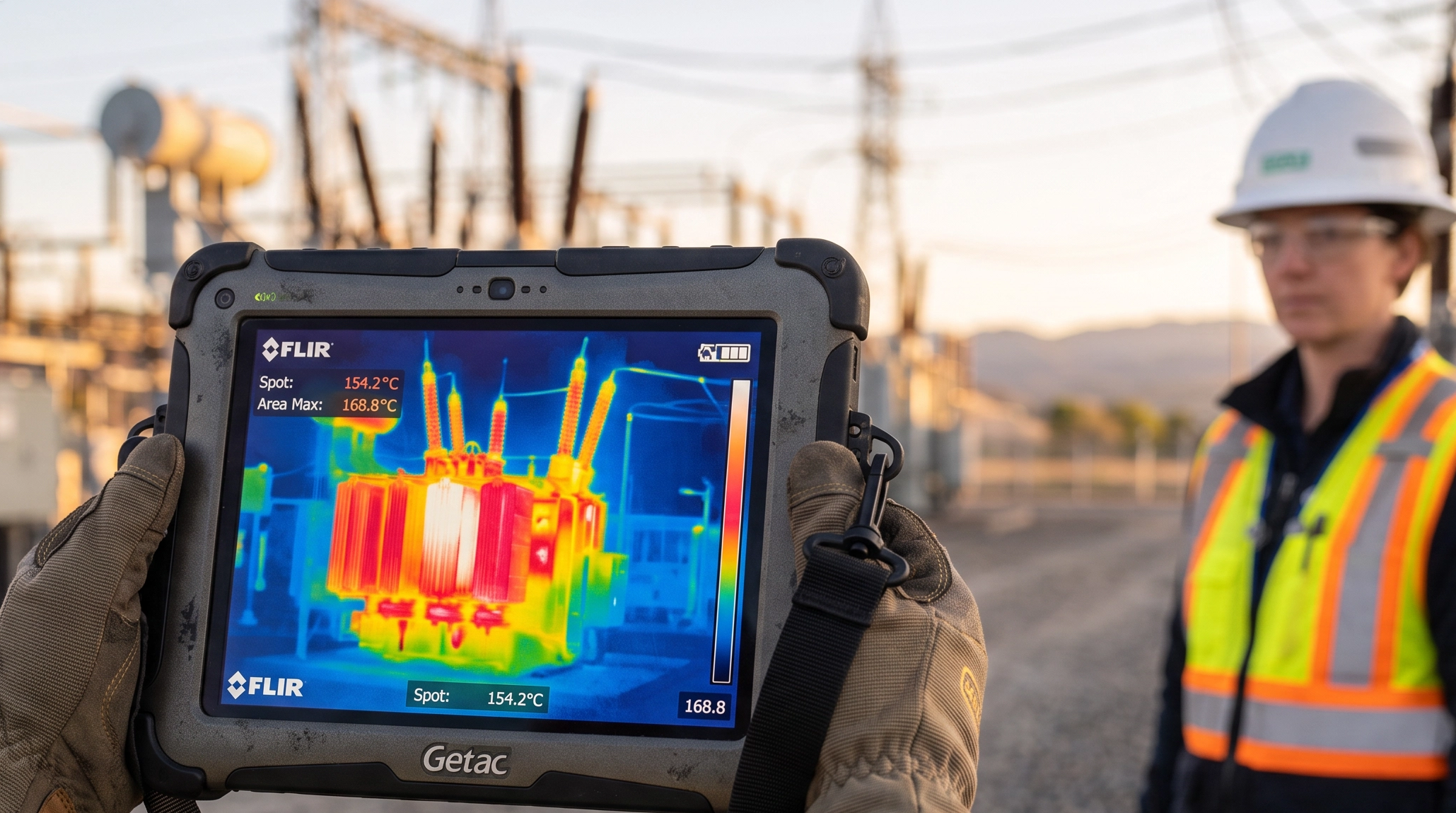
The primary driver for adopting thermal imaging in the utility sector is overheating component detection in field work. When a transformer coil degrades, a substation connection loosens, or an insulator cracks, the electrical resistance at that specific junction increases, creating a distinct hot spot.
With a thermal camera, a technician scanning a substation from a safe distance can instantly see these high-temperature anomalies glowing brightly on their screen. This allows crews to pinpoint failing relays and degrading switchgear without needing to power down the grid or physically touch dangerous high-voltage equipment. Identifying these faults weeks or months before a component actually burns out is the core predictive maintenance utilities rely on.
Gas Leak Detection and Hard-to-Access Asset Inspection
Infrared inspection is not limited to the electrical grid. It is equally vital for gas and water utilities. Gas leak detection in thermal imaging works on the principle of thermodynamics. When pressurized gas escapes a valve or pipeline crack, it rapidly expands. This expansion cools the immediate surrounding area. A thermal camera visualizes this localized temperature drop, allowing workers to see the invisible gas leak instantly.
Also, integrated thermal cameras excel in hard-to-access asset inspection. Whether scanning underground vaults, surveying high-tension wires, or inspecting cramped pipeline corridors, a technician can simply point their rugged device to capture a comprehensive thermal profile of the entire area in seconds.
Also Read: Rugged Tablets for Utility Field Operations: The Complete Technology Buying Guide (2026)
Rugged Tablet Thermal Imaging Specifications
Historically, utility teams carried separate, fragile thermal cameras alongside their field laptops. Today, the most efficient solution is a unified FLIR thermal camera rugged device. Purpose-built rugged tablets integrate enterprise-grade thermal sensors directly into their chassis, allowing technicians to capture thermal data, annotate it, and sync it to the enterprise GIS database from a single device.
Here is a comparison of standard field inspection versus utilizing an integrated rugged thermal tablet:
| Inspection Method | Diagnostic Capability | Data Integration | Device Portability & Ruggedness |
| Standard Visual Inspection | Low: Can only detect visible physical damage (rust, breaks). | Manual: Requires separate paper logs or manual tablet entry. | Standard tablet/clipboard. No specialized sensors. |
| Separate Handheld Thermal Camera | High: Accurately detects heat anomalies. | Fragmented: Requires transferring images from camera to tablet via USB/Wi-Fi. | High risk of dropping/breaking two separate fragile devices. |
| Rugged Tablet with Integrated FLIR | High: Pinpoints exact thermal anomalies instantly. | Seamless: Thermal images are automatically tagged with GPS and saved to GIS work orders. | Single, IP66-rated indestructible unit built for extreme field work. |
The industry standard for integrated thermal hardware uses the FLIR Lepton 3.5 sensor. This sensor is explicitly designed for industrial diagnostics, featuring a thermal resolution of 160×120 pixels and a highly versatile scene dynamic range capable of measuring temperatures from -10°C to +140°C.
FLIR Lepton 3.5 Specifications
Thermal resolution: 160×120 pixels (19,200 thermal measurement points per frame)
Temperature detection range: -10°C to +140°C
Measurement accuracy: ±2°C or ±2% of reading
Thermal sensitivity (NETD): <50 mK at f/1.1 – detects temperature differentials under 0.05°C
Spectral range: 8–14 µm (longwave infrared – the range that corresponds to ambient temperature object emission)
Frame rate: 8.7 Hz (standard export-controlled FLIR rate)
G-Thermo Software: Improving Predictive Maintenance
Hardware must be paired with intelligent software to be effective. Getac’s proprietary G-Thermo software is engineered specifically to maximize the utility of the integrated FLIR camera.
G-Thermo allows field technicians to toggle through multiple color palettes such as Iron, Rainbow, or Gray to best highlight specific thermal contrasts. More importantly, it enables users to tap anywhere on the screen to capture exact spot temperatures, track the hottest and coldest points in a frame dynamically, and generate instant, annotated PDF thermal reports directly from the field. This capability eliminates hours of back-office paperwork and ensures that maintenance engineers receive actionable data immediately.
Equipping Your Field Teams with Getac F120 and UX10-G5
Executing thermal cameras for utility inspection requires enterprise-grade, indestructible hardware. Consumer tablets cannot host thermal cameras, nor can they survive the drops, dust, and extreme heat of a utility job site.
We recommend standardizing your field workforce on the Getac F120 or the Getac UX10-G5 fully rugged tablets, both of which can be custom-configured with the integrated FLIR thermal camera option. These IP66-rated devices feature sunlight-readable displays and hot-swappable batteries, providing your technicians with an all-in-one command center for GIS mapping, work order processing, and advanced thermal diagnostics.

The Getac F110 is recommended for utility field teams requiring the full modular expansion capability with thermal camera, RS232 serial I/O, barcode, and RFID interchangeably in the same device. The UX10 G5 suits teams whose primary requirement is thermal inspection and GIS data collection in a slightly more compact form factor.

Getac F110 vs UX10 G5: Thermal Camera Configuration Specifications
| Specification | Getac F110 | Getac UX10 G5 |
| Thermal camera | Optional FLIR Lepton 3.5 module (expansion bay) | Optional FLIR Lepton 3.5 (integrated expansion) |
| Thermal resolution | 160×120 pixels (FLIR Lepton 3.5) | 160×120 pixels (FLIR Lepton 3.5) |
| Thermal temperature range | -10°C to +140°C | -10°C to +140°C |
| Thermal accuracy | ±2°C or ±2% of reading (whichever is greater) | ±2°C or ±2% of reading (whichever is greater) |
| Thermal software | G-Thermo integrated software (geo-tagged image capture, report export) | G-Thermo integrated software |
| Visual camera | 8 MP rear camera with geo-tag | 13 MP rear camera with geo-tag |
| GNSS / RTK | GPS + GLONASS + BeiDou + Galileo; RTK-capable with correction link | GPS + GLONASS + BeiDou + Galileo; RTK-capable |
| Operating temperature | -21°C to +60°C | -21°C to +63°C |
| Ingress protection | IP65, MIL-STD-810H | IP66, MIL-STD-810H |
| Drop resistance | 1.8 m (MIL-STD-810H) | 1.8 m (MIL-STD-810H) |
| Display (sunlight readable) | 11.6″, 1000 nit | 10.1″, 1000 nit |
| Modular expansion | Thermal, barcode, RS232, smart card, RFID (interchangeable) | Thermal, barcode, NFC (integrated expansion options) |
| OS / GIS compatibility | Windows 11: ArcGIS Field Maps, G-Thermo, SCADA clients | Windows 11: ArcGIS Field Maps, G-Thermo |
Amplicon Middle East is the premier authorized Getac distributor and systems engineering partner in the GCC.
Contact us today to arrange a hardware demonstration of the Getac F120 or UX10-G5 for your utility maintenance teams.
FAQ
What is thermal camera utility inspection?
Thermal camera utility inspection involves using infrared technology to visualize heat patterns in electrical and gas infrastructure. By identifying abnormal heat signatures, technicians can spot failing transformers, degraded insulators, or leaks instantly.
What temperature range can a rugged tablet thermal camera detect?
Integrated rugged tablet thermal cameras, such as those utilizing the FLIR Lepton 3.5 sensor, can accurately detect surface temperatures ranging from -10°C to +140°C.
How does infrared inspection improve predictive maintenance for utilities?
Infrared inspection allows field workers to identify degraded components long before they physically break or catch fire. By integrating thermal imaging into routine asset audits, utility providers transition from reactive emergency repairs to scheduled, predictive maintenance, significantly reducing downtime and operational costs.
Can thermal imaging detect gas leaks in utility pipelines?
Yes, thermal imaging is highly effective for gas leak detection. When pressurized gas escapes a pipeline, it rapidly expands and cools the surrounding area. A thermal camera detects this localized temperature drop, instantly highlighting the leak location on the screen for swift repair.
Why integrate a FLIR thermal camera into a rugged device?
Integrating a FLIR thermal camera into a rugged device eliminates the need for technicians to carry multiple fragile tools. It combines predictive maintenance diagnostics, enterprise GIS mapping, and digital work order processing into one indestructible unit designed for harsh field environments.
Can a thermal camera detect electrical wires?
Thermal cameras cannot see through solid walls to detect unpowered wires, but they can easily detect the heat generated by active electrical wires. When a wire is under heavy load, has a loose connection, or is failing, the electrical resistance creates a distinct heat signature that warms the surrounding insulation or panel.
What are the best thermal imaging cameras?
For industrial utility applications in the UAE, the best thermal imaging cameras are integrated into fully ruggedized field devices rather than standalone, fragile units. Devices utilizing the enterprise-grade FLIR Lepton 3.5 sensor such as the custom-configured Getac F120 or Getac UX10-G5 tablets are considered industry leaders because they combine high thermal resolution with extreme durability and direct GIS software integration.