Most buildings worth instrumenting were built before anyone planned for it. Running new cable to add energy monitoring, IAQ sensors, or leak detection in a functioning commercial building is disruptive enough that most projects never happen at all. LoRaWAN for smart buildings changes that equation.
LoRaWAN solves this issue without rewiring. In this guide, let’s see how deploying wireless sub-metering and environmental telemetry alongside edge gateways allows building operators to bridge wireless sensor data directly into legacy building automation protocols like BACnet and Modbus.
The Retrofit Problem: Cabling Occupied Facilities
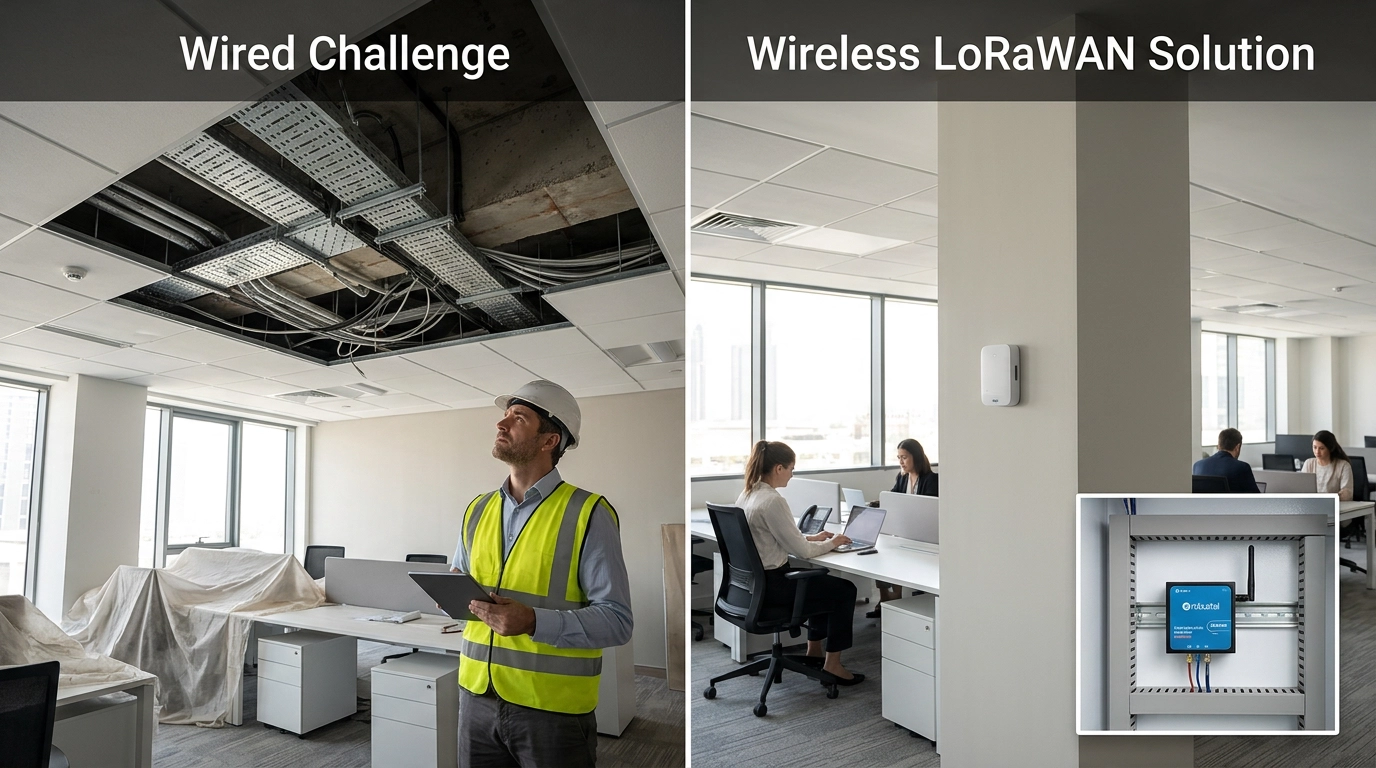
Every building engineer understands the high cost of physical copper runs. It requires:
Extensive Labor & Material Costs: Running conduits, pulling shielded twisted-pair cables through drop ceilings, and navigating vertical utility risers.
Tenant Disruption: Noisy core drilling, dust generation, and scheduled outages inside tenanted suites during business hours.
Structural Limitations: Historic architecture, post-tensioned concrete slabs, and sealed glass facades where wall-chasing is physically impossible or restricted.
When calculating the total installed cost of a traditional wired sensor network, physical labor and containment materials can account for up to 70% to 80% of the entire project budget. Also, wired layouts lock building layouts into rigid topologies. When interior floorplans are reconfigured for new tenants, moving a wired wall sensor requires re-pulling cables and patching drywall.
LoRaWAN lets building teams add sensing and metering where cabling is impractical — without rewiring.
What LoRaWAN Adds to a Building: Sensors, Metering, and Propagation
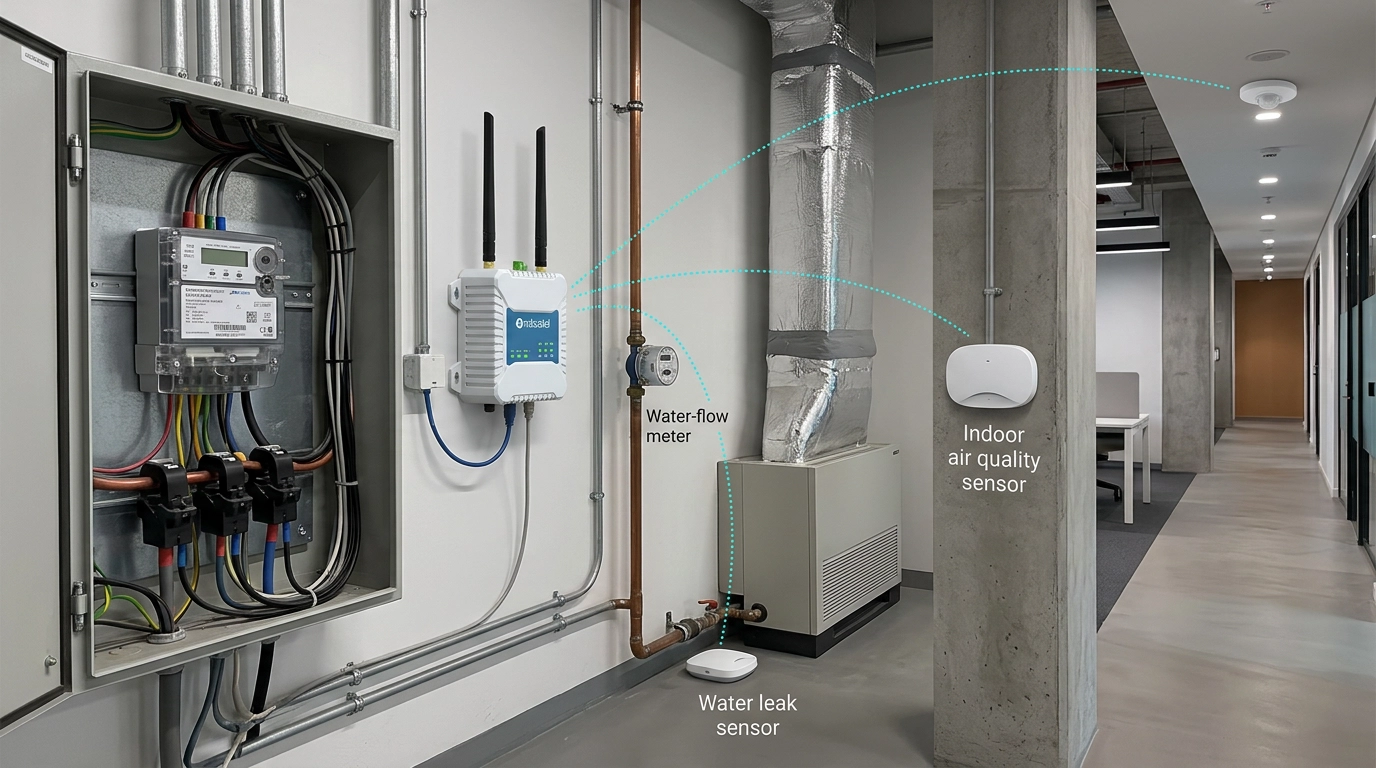
LoRaWAN is specifically engineered to solve the physical limitations of earlier short-range wireless technologies like Wi-Fi or Zigbee. The sensor ecosystem available on LoRaWAN today covers every monitoring requirement a building team is likely to face. Common use cases by category include:
- Indoor Environmental Quality (IEQ): Monitoring CO2, volatile organic compounds (VOCs), ambient temperature, relative humidity, and light levels to maintain occupant wellness.
- Energy & Utility Sub-Metering: Retrofitting pulse counters, CT clamps, M-Bus converters, and ultrasonic flow meters onto water, gas, electricity, and BTU lines.
- Facility Protection: Spot water leak detectors placed under HVAC drain pans, server room raised floors, and plumbing chases to prevent catastrophic water damage.
- Space Utilization: Infrared desk-occupancy sensors, foot-fall counters, and smart door contact monitors to optimize cleaning schedules and flexible workplace allocations.
- Smart HVAC Control: Wireless radiator thermostatic valves (TRVs) and fan coil unit (FCU) controllers that receive setpoint commands wirelessly.
Range: What to Expect Inside a Building
LoRaWAN’s non-line-of-sight (NLoS) penetration through building materials is one of its core advantages over alternatives like Zigbee or BLE mesh. Empirical deployments report reliable links through approximately 5 floors vertically and 6 poured-concrete walls horizontally from a single gateway.
In a normal commercial building, a single Robustel gateway positioned centrally can cover the full floor plate and multiple levels above and below, often the entire building from one device.
Range in line-of-sight conditions such as rooftop, outdoor parking, or across a campus extends to approximately 10 km. For multi-building estates, a single outdoor-mounted gateway can often cover the entire site.
Also Read: Robustel LoRaWAN Gateway Portfolio: How to Choose the Right Gateway
The Integration Question: Getting Data into Your BMS
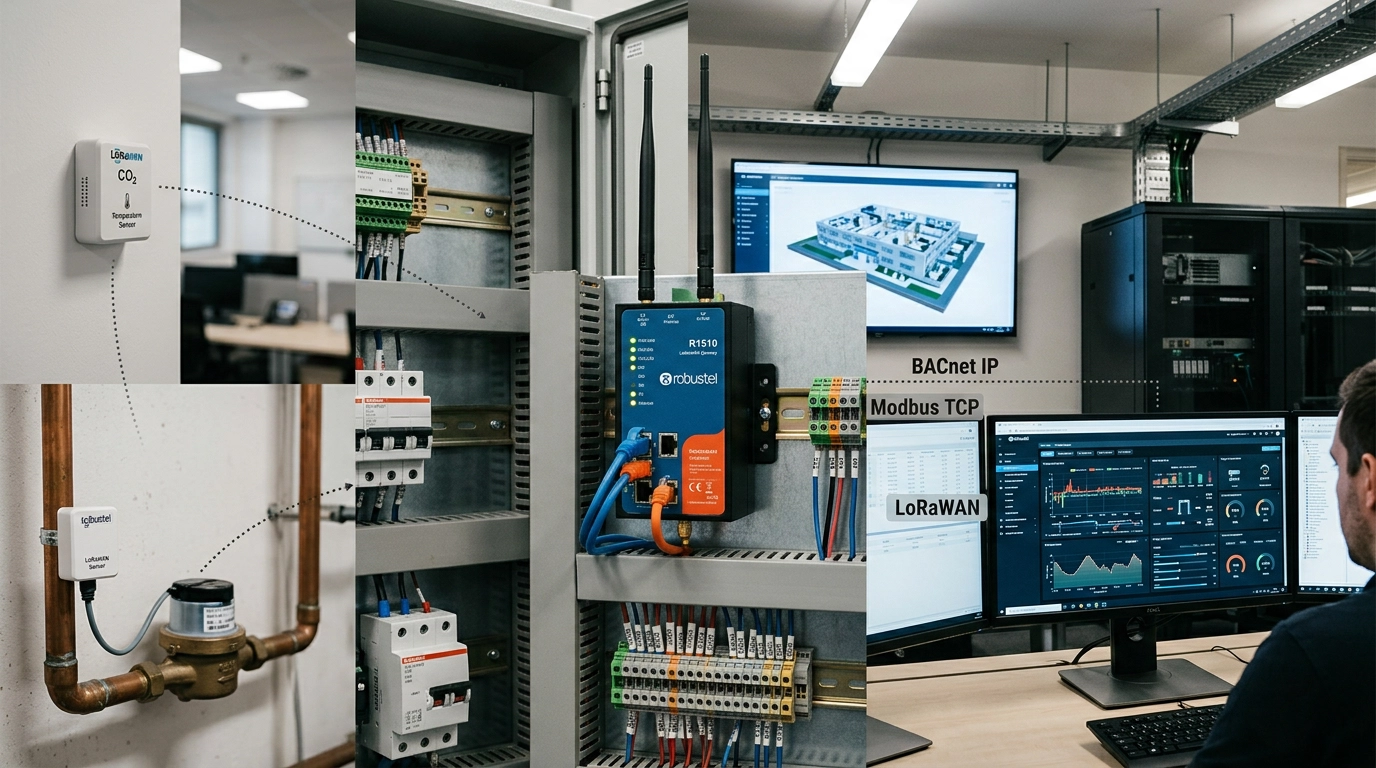
Deploying LoRaWAN for smart buildings does not require replacing your established BMS platform. Instead, modern gateways act as protocol translators that convert raw wireless telemetry into native building automation protocols.
Protocol Translation: BACnet, Modbus, KNX, and M-Bus
To achieve seamless LoRaWAN BMS integration, edge computing gateways intercept encrypted radio packets, decode the hex payload locally, and map the telemetry directly into standardized automation objects:
- BACnet IP/BACnet MS/TP: Wireless sensor variables (e.g., room temperature or CO2 concentration) are mapped directly to BACnet AV or BI points. The BMS sees the wireless gateway as a standard BACnet controller.
- Modbus TCP/Modbus RTU: Telemetry values are mapped into Modbus holding registers, enabling legacy industrial controllers and PLCs to read LoRaWAN data directly over RS485 or Ethernet.
- M-Bus & KNX: Advanced facility gateways such as the upcoming Robustel LG5120 integrate hardware interfaces for M-Bus and KNX, unifying wired sub-metering topologies and building automation networks under a single processing node.
Edge vs. Cloud Architecture: Reducing Tool Sprawl
Earlier wireless deployments forced building operators to route sensor data out to a third-party cloud platform, process the payload externally, and pull it back into the local BMS via web APIs. This cloud-dependent approach introduces recurring subscription costs, latency, internet bandwidth consumption, and severe security risks if external connectivity drops.
By úsing intelligent edge gateways such as the Robustel R1520LG, LG3120e, or LG5120, the LoRaWAN Network Server lives locally on the gateway hardware. The entire network server, payload decoder, and BACnet IP server reside on-site inside the facility control cabinet. Data travels from the wireless sensor to the BMS in milliseconds without ever leaving the local building network.

LoRaWAN Sub-Metering for Tenant Billing & ESG Reporting
Accurate utility sub-metering is essential for modern commercial real estate, driven by regulatory demands, corporate ESG reporting, and tenant cost allocation. However, installing wired sub-meters in existing electrical risers, basements, and cramped mechanical closets is notoriously difficult.
Wireless LoRaWAN sub-meters solve this cleanly. Meters are installed at distribution boards, riser cupboards, plant room connections, and individual tenant supply points wherever the electrical or pipework infrastructure is already accessible without needing to run data cable back through the finished structure. The LoRa radio signal carries readings to the gateway through walls and floor slabs.
Cellular backhaul on the Robustel gateway keeps metering data traffic off the corporate or tenant LAN which are important in buildings where the landlord and tenants operate separate networks, and where mixing metering traffic with tenant infrastructure creates either security concerns or commercial complications.
On the ESG and compliance side, granular wireless sub-metering enables the consumption data that LEED, BREEAM, and Estidama reporting in the UAE require. Data accuracy for audits, NABERS energy ratings, and Dubai Green Building Regulations is significantly improved over the manual meter reads or estimates that most occupied buildings currently rely on.
LoRaWAN Deployment in Dubai: The Robustel and Voytech Systems

The real-world viability of replacing traditional BMS cabling with wireless LoRaWAN infrastructure is demonstrated in a landmark deployment by Voytech Systems in collaboration with Robustel.
The Architecture: R1520-LG + Sitelink + BACnet
Voytech’s deployed architecture uses battery-powered LoRaWAN sensors and actuators including MClimate Vicki smart radiator valves placed throughout building rooms and plant spaces. These devices transmit over LoRa radio to Robustel R1520-LG gateways, which forward encrypted LoRaWAN payloads over IP to a Voytech Sitelink Controller installed on site.
Critically, the Sitelink Controller hosts both the LoRaWAN Network Server and Application Server locally. This means monitoring and control functions operate independently of internet connectivity. Within Sitelink, LoRaWAN messages are decrypted, decoded, and mapped into BACnet objects representing individual temperatures, valve positions, binary statuses, and setpoints.
When coverage needs extending, integrators simply add extra R1520-LG gateways; LoRaWAN treats them as part of a single distributed antenna system, making densification straightforward without reconfiguring the network or end devices.
Deployment Results
Reported outcomes from Voytech’s field deployments:
200+ sensors in a three-storey office: All communicating reliably with R1520-LG gateways installed inside plant rooms.
14-floor link range demonstrated: In a London proof-of-concept, LoRa links spanned 14 floors of a commercial building which is far beyond what the three-storey deployment required, confirming substantial link margin for GCC high-rise applications
100-metre off-site range: Sensors stored in a separate building 100 metres away during pre-deployment staging communicated reliably with the installed gateways.
60 Vicki smart radiator valves in one project: Integrated via Sitelink, enabling central plant and distributed room heating control without any new wiring outside the plant room
Contractor-install commissioning: Devices delivered pre-configured; standard electrical contractors fitted them without LoRaWAN expertise, keeping labour costs controlled and eliminating specialist radio engineers from the commissioning process
No new wiring outside the plant room: The entire sensor and valve network was deployed without cabling through finished building structure
FAQ: LoRaWAN for Smart Buildings
Can LoRaWAN sensors integrate with an existing BMS?
Yes. By using an edge gateway with protocol translation capabilities such as the Robustel R1520LG or LG3120e, LoRaWAN sensor payloads are converted locally on-site into standard protocols like BACnet IP, Modbus TCP, KNX, or M-Bus.
How does LoRaWAN reduce sub-metering costs in a building?
LoRaWAN lowers installation costs by removing the need for physical cabling, conduit runs, wall chasing, and core drilling between floor risers and meters.
Does LoRaWAN work through concrete floors and walls?
Yes. Operating on sub-gigahertz radio frequencies, LoRaWAN features exceptional physical obstruction penetration. Under typical indoor conditions, a single gateway can reliably receive transmissions through approximately 5 concrete floors vertically or through up to 6 solid walls without requiring line-of-sight.
LoRaWAN vs wired sensors for building retrofits — which is cheaper?
For existing or occupied properties, LoRaWAN is significantly cheaper. LoRaWAN cuts total cost of ownership dramatically by drastically reducing installation time and eliminating ongoing cable maintenance.
How many sensors can one LoRaWAN gateway support in a building?
A standard 8-channel industrial LoRaWAN gateway built on the Semtech SX1302 baseband processor can comfortably support up to 2,000 end-nodes, depending on payload sizes and transmission frequencies.
Deploying Wireless Building Project in the Middle East
Transitioning your property portfolio to smart, automated building management no longer requires invasive cabling projects or astronomical installation budgets. Deploying LoRaWAN for smart buildings provides the exact balance of deep in-building range, long battery life, and seamless protocol integration needed to unlock true operational efficiency.
As the leading distributor and systems engineering Robustel partner across the GCC, Amplicon Middle East works alongside MEP consultants, BMS integrators, and facilities leaders to specify, stage, and deploy robust wireless building infrastructure.
Looking to integrate LoRaWAN into your BMS?
Contact our engineering team directly to request technical architecture advice for your next project across the UAE and GCC region.