When designing or evaluating a LoRaWAN, system integrators and IT professionals frequently encounter overlapping networking terminology. Is a LoRaWAN gateway vs router the same comparison as a Wi-Fi router vs modem? What is the difference between a packet forwarder vs LNS (LoRaWAN Network Server)? And do you need a standalone network server if your gateway already has processing power?
Misunderstanding these architectural components can lead to costly specifying errors such as buying expensive edge compute gateways when simple packet forwarders would suffice, or realizing too late that your offline facility lacks an embedded network server.
In this guide, we break down the exact functions, architectural positions, and operational differences between LoRaWAN gateways, routers, packet forwarders, and network servers .
LoRaWAN Gateway vs Network Server vs Packet Forwarder at a Glance
A LoRaWAN gateway is the hardware device that receives LoRa radio signals from sensors and forwards them over IP to a network server. It is the radio access point of a LoRaWAN network.
A packet forwarder is the software running on a basic gateway. It forwards raw encrypted packets upstream without any intelligence. The term describes what the simplest class of gateway software does.
A LoRaWAN Network Server (LNS) is the software layer that manages the network: authenticating devices, deduplicating packets, handling MAC protocol, and routing payloads to applications. It can run in the cloud or locally on the gateway itself.
These three things exist at different layers and are not substitutes for one another. A functioning LoRaWAN network requires all three. What varies is where each function runs and how much of it is combined into a single device.
Here’s a comparison table that maps the key attributes:
| Component | Primary Function | OSI Layer | Holds Encryption Keys? | Executes Local Logic? |
| Wi-Fi/IP Router | Routes IP traffic between subnets | Layer 3 (Network) | No (IP Security) | Yes (Firewall/DHCP) |
| Packet Forwarder | Relays raw RF packets to LNS | Layer 1 (Physical) | No | No |
| LoRaWAN Gateway (Basic) | Hardware hosting packet forwarder | Layer 1/2 | No | No |
| Network Server (LNS) | De-duplication, Auth, ADR, Routing | Layer 2/3 (MAC) | Yes (NwkSKey/AppSKey) | Yes (Network Management) |
| Edge Gateway | Local LNS + Protocol Translation | Layers 1–7 | Yes (when hosting LNS) | Yes (BACnet, Modbus, Alarms) |
LoRaWAN Gateway vs Router: Why They’re Not the Same Thing
The phrase LoRaWAN gateway vs router is one of the most common points of confusion for traditional IT networking teams entering the IoT space. Because enterprise IT relies heavily on Wi-Fi access points and IP routers, it is easy to assume a LoRaWAN gateway functions identically to a wireless router.
Here’s the actual distinction:
A Wi-Fi router operates at 2.4 GHz or 5 GHz, uses the 802.11 protocol family, manages IP addresses (DHCP), routes traffic between LAN and WAN, and connects devices like laptops, phones, and smart speakers. It is designed for high-bandwidth, short-range connectivity usually covering a room or a floor.
A LoRaWAN gateway operates at sub-GHz frequencies (868 MHz or 923 MHz in the Middle East), uses the LoRa radio modulation and LoRaWAN protocol, does not assign IP addresses, does not route IP traffic between devices, and connects low-power sensors that transmit tiny packets infrequently. It is designed for low-bandwidth, long-range connectivity covering a building, a campus, or several kilometres of terrain.
The word “gateway” in LoRaWAN refers specifically to the bridge between the LoRa radio network and the IP network and not to IP routing between devices. In practice, a LoRaWAN deployment often includes both: the LoRaWAN gateway for sensor connectivity, and a standard IP router for the cellular or wired backhaul that carries gateway traffic to the internet.
Also Read: LoRaWAN Gateway Explained: How It Works & What It’s For
What a Packet Forwarder Actually Does
A packet forwarder is a lightweight application running directly on the gateway’s operating system, usually embedded Linux. It serves as the bridge between the Semtech baseband radio chip such as the Semtech SX1302 or SX1303 and the IP network interface.
The Mechanics of Packet Forwarding
When a field sensor broadcasts telemetry:
- The gateway antenna receives the sub-gigahertz radio wave.
- The baseband processor demodulates the signal into raw binary payload frames.
- The packet forwarder software attaches metadata to the frame including Received Signal Strength Indicator (RSSI), Signal-to-Noise Ratio (SNR), exact timestamp, and gateway ID.
- The forwarder encapsulates this metadata and raw payload into an IP transport protocol traditionally Semtech UDP, or modern encrypted protocols like MQTT or Semtech Basics Station and transmits it over Ethernet, Wi-Fi, or cellular backhaul to an external server.
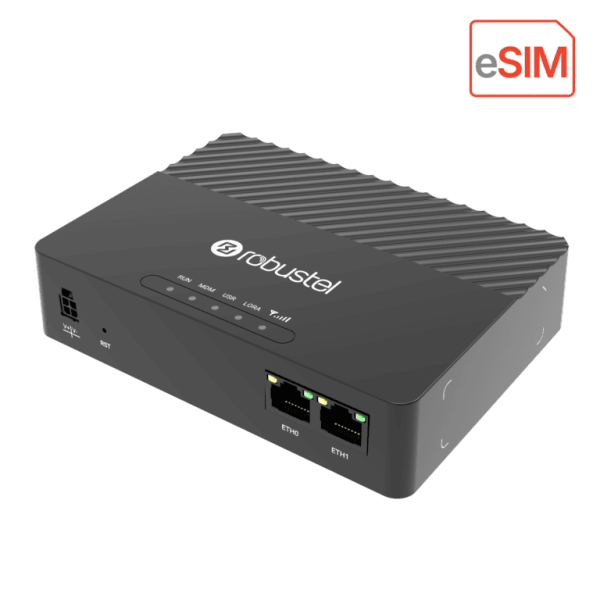
A pure packet forwarder such as the Robustel R1320LGe possesses zero local decision-making intelligence. It cannot validate whether a sensor belongs to the network, cannot decrypt the data, and cannot trigger local actions if the internet backhaul fails.
What a LoRaWAN Network Server (LNS) Does
The LoRaWAN Network Server is the brain of the LoRaWAN network. While the gateway handles the radio, the LNS handles the network. Its core functions are:
Device authentication: Manages OTAA (Over-the-Air Activation) join procedures and ABP (Activation by Personalisation) session keys. Device keys never leave the LNS — this is where LoRaWAN’s security model is enforced.
Deduplication: When multiple gateways receive the same uplink (common in well-designed networks), the LNS identifies duplicate packets and passes only one copy to the application server, using the strongest signal for RSSI/SNR metadata.
MAC layer management: Handles LoRaWAN MAC commands including adaptive data rate (ADR), receive window timing, link check requests, channel configuration. Optimises the network for capacity and battery life.
Downlink scheduling: Selects which gateway transmits a downlink and schedules it within the precise receive window the end device expects.
Application routing: Decrypts the application layer payload and routes it to the correct application server via MQTT, HTTP, or other integration methods.
Cloud LNS vs Embedded LNS
The LNS can run in two locations:
Cloud-hosted LNS: Platforms like The Things Network (TTN), Actility, Everynet, and AWS IoT Core for LoRaWAN host the LNS in the cloud. The gateway forwards packets to the cloud LNS over the internet. Simpler to deploy, no on-premise server required, but creates a dependency on WAN connectivity and ongoing subscription costs.
Embedded LNS (on-gateway ChirpStack): Some gateways including the Robustel R1520LG run an open-source LNS called ChirpStack locally on the gateway hardware. The complete LoRaWAN network operates on-device, independent of cloud connectivity. ChirpStack is the dominant open-source LoRaWAN Network Server, providing a full web interface for device management, packet inspection, and integration configuration.
Gateway with Built-in LNS vs. Edge Gateway
Integrated LNS Gateways

Devices in this category such as the Robustel R1520LG host a lightweight LNS directly on the hardware. This setup is ideal for isolated sites, water treatment facilities, or agricultural fields where cellular connections may drop intermittently. The gateway decrypts data locally and stores or pushes it to local dashboards without needing cloud reachability.
Edge Gateway
Edge gateways such as the Robustel LG3120e or upcoming LG5120 go beyond network management. In addition to running a local LNS, they feature powerful multi-core processors and protocol translation engines like E2C Trinity Field or Niagara Framework.
An edge gateway can ingest raw LoRaWAN sensor data, decode the payload, convert the values into native BACnet IP or Modbus TCP registers, and serve them directly into a Building Management System (BMS) in real time.
Also Read: LoRaWAN for Smart Buildings: Wireless Sub-Metering & BMS Integration Without Rewiring
Indoor vs. Outdoor Gateway
Form factor is a separate dimension from capability. Any gateway tier like packet forwarder, built-in LNS, or edge gateway can come in indoor or outdoor form factors. The differences are in housing, certification, antenna, and backhaul:
| Factor | Indoor Gateway | Outdoor Gateway |
| Enclosure | Plastic or metal, standard commercial | IP67/IP65 weatherproof, UV-resistant |
| Temperature | 0°C to +50°C (commercial) | −40°C to +70°C (industrial/outdoor) |
| Antenna | Internal omni or RP-SMA connector | External N-type connector; pole-mount antenna |
| Primary backhaul | Ethernet + Wi-Fi | 4G/LTE cellular; Ethernet where available |
| Mounting | Wall mount, DIN rail, rack | Pole mount, wall mount (outdoor bracket) |
| Typical applications | Building comms rooms, factory floors, retail | Utility poles, rooftops, street furniture, remote sites |
| OTD6710 option | — | Robustel OTD6710 IP67 enclosure converts supported indoor models for outdoor pole-mount deployment |
System integrators often prefer standardizing on a single indoor edge gateway model across an entire enterprise. To deploy indoor industrial hardware in harsh external environments such as desert installations across the GCC, engineers use specialized weatherproofing enclosures like the Robustel OTD6710 IP67 Enclosure. This housing protects indoor industrial units from rain, blowing sand, and extreme temperature variations while providing high-gain external antenna pass-throughs.
Which Setup Do You Need? A Decision Checklist
Run through these questions to determine the right combination of gateway, LNS, and form factor for your project:
| If your project… | Choose… |
| Already has a cloud LNS (TTN, Actility, AWS IoT) | Packet forwarder gateway (R1320LGe) |
| Needs local LNS (offline, data sovereignty, distributed sites) | Gateway with built-in LNS (R1520LG + ChirpStack) |
| Has legacy serial devices to integrate (Modbus, RS485) | R1520LG: Adds RS232/RS485 alongside local LNS |
| Needs data acted on locally (alarms, outputs, BMS/BACnet/Modbus integration) | Edge gateway (LG3120e): Local compute + protocol bridge |
| Is a full BMS project (KNX, M-Bus, Niagara, multi-protocol) | Advanced edge gateway (LG5120): Full facility automation stack |
| Deploys outdoors (utility poles, rooftops, remote sites) | Outdoor-rated gateway or indoor model in OTD6710 IP67 enclosure |
| Needs WAN redundancy (carrier failover) | Dual SIM gateway (R1520LG, LG3120e): Primary + backup SIM |
FAQ: LoRaWAN Gateway vs Router
Is a LoRaWAN gateway the same as a router?
No. A LoRaWAN gateway is a radio transceiver operating at the physical layer that converts sub-gigahertz radio signals into IP packets. It does not assign IP addresses to sensors, perform network routing between subnets, or function like a Wi-Fi or enterprise ethernet router.
Do I need a LoRaWAN Network Server?
Yes. Every functional LoRaWAN network strictly requires a LoRaWAN Network Server somewhere in its architecture. Without an LNS, radio packets captured by gateways cannot be authenticated, decrypted, de-duplicated, or decoded into usable application data.
Can a LoRaWAN gateway run its own network server?
Yes. Modern industrial LoRaWAN gateways such as the Robustel R1520LG and LG3120e feature sufficient CPU capacity and RAM to host an embedded LNS such as ChirpStack directly on the hardware.
What is the difference between a packet forwarder and an LNS?
A packet forwarder is lightweight software running on the gateway that simply captures raw RF packets and forwards them upstream over IP. The LNS is the intelligent software engine that receives those packets, removes duplicates, validates security keys, manages sensor join requests, and routes clean payloads to end applications.
What is ChirpStack?
ChirpStack is a leading open-source LoRaWAN Network Server stack. It provides a clean web management interface, device profiles, payload decoders, and API integrations.
Conclusion: Network Deployment in the Middle East
Understanding the distinct roles of LoRaWAN gateways, routers, packet forwarders, and network servers in the Middle East ensures you choose hardware that aligns precisely with your software architecture.
For most projects in the UAE and GCC, Amplicon Middle East recommends starting with the Robustel portfolio which covers all three gateway capability tiers, indoor and outdoor form factors, and both cloud-forwarding and embedded LNS configurations. Our engineering team can help you map the right architecture to your project requirements before you buy.
Read our complete comparison of models in the Robustel LoRaWAN Gateway Portfolio to explore gateway hardware options.
Contact Amplicon Middle East to spec the right LoRaWAN architecture for your project.