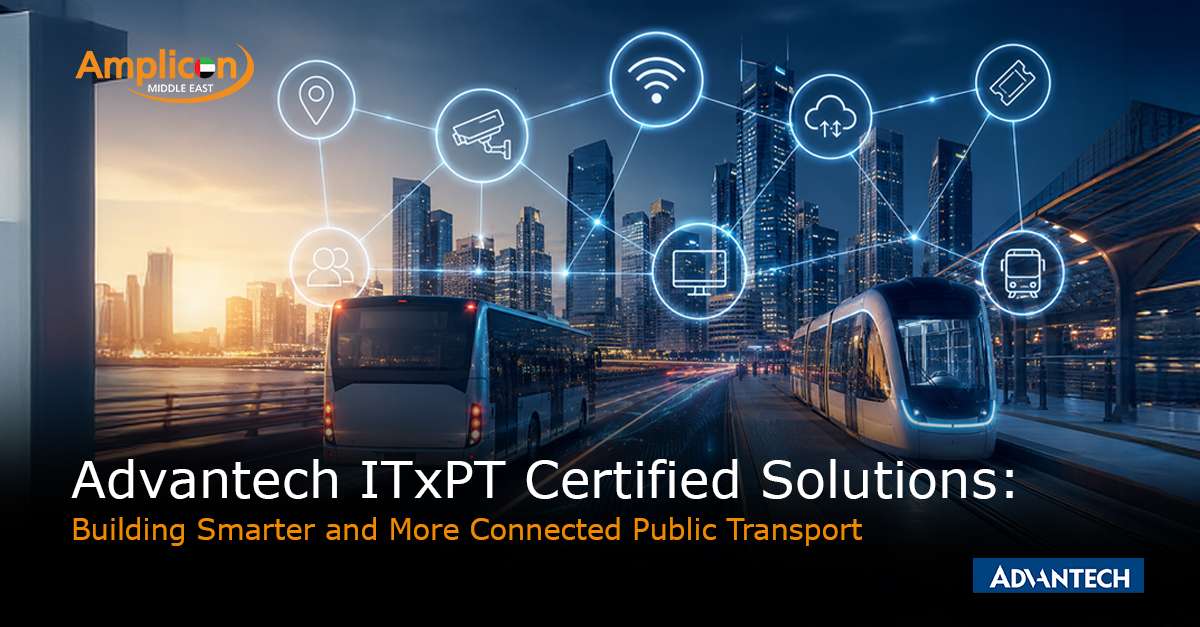
The technology inside a modern bus, tram, or rail vehicle is considerably more complex than it was a decade ago. Passenger information displays, CCTV cameras, ticketing validators, vehicle telemetry systems, GNSS location modules, and fleet management connections all share a vehicle network that must remain reliable through vibration, temperature extremes, and constant power cycling over years of operational life.
When each of these systems is sourced from a different supplier using proprietary interfaces, the result is an integration challenge that grows with every new capability added and a maintenance burden that falls on operators who may need to manage multiple vendor relationships for a single vehicle. Interoperability standards exist precisely to address this.
This is where ITxPT certified technology can play an important role. Advantech has joined ITxPT with certified solutions including the TREK 60 rugged in vehicle computer and EKI 9508/9510 ST industrial M12 Ethernet switches. The adoption of ITxPT standards is intended to support open interoperability, scalable architectures and easier maintenance for public transport applications.
Why Public Transport Systems Need Open Connectivity
The technology stack inside a modern transit vehicle has grown substantially. Where an older bus might have carried a radio and a destination display, a current-generation vehicle is likely running several systems simultaneously, each with its own data requirements such as:
| System | Function |
| In-vehicle computer | Central computing platform managing vehicle applications and data |
| Passenger information | Real-time displays, audio announcements, next-stop information |
| CCTV and surveillance | Onboard and route-facing cameras, recording and streaming |
| Vehicle telemetry | Engine data, fuel consumption, door events, speed, diagnostics |
| GNSS location | GPS/GNSS positioning for schedule adherence and fleet management |
| Ticketing and validation | Contactless payment terminals, ticket validators, revenue systems |
| Fleet management | Real-time vehicle tracking, operator communication, remote management |
| Onboard networking | Ethernet backbone connecting all onboard systems through the vehicle |
When these systems arrive from different suppliers using different interfaces, communication protocols, and data formats, the operator faces several compounding challenges like:
- Integration complexity: connecting proprietary systems requires custom integration work for each combination of supplier and vehicle type
- Maintenance burden: diagnosing faults across closed systems requires specialist knowledge that may be held only by individual vendors
- Scalability constraints: adding new capabilities or upgrading individual components may require renegotiating proprietary interfaces or replacing surrounding systems
- Fleet diversity: mixed fleets with vehicles from different procurement cycles may have incompatible technology generations that cannot share management tools
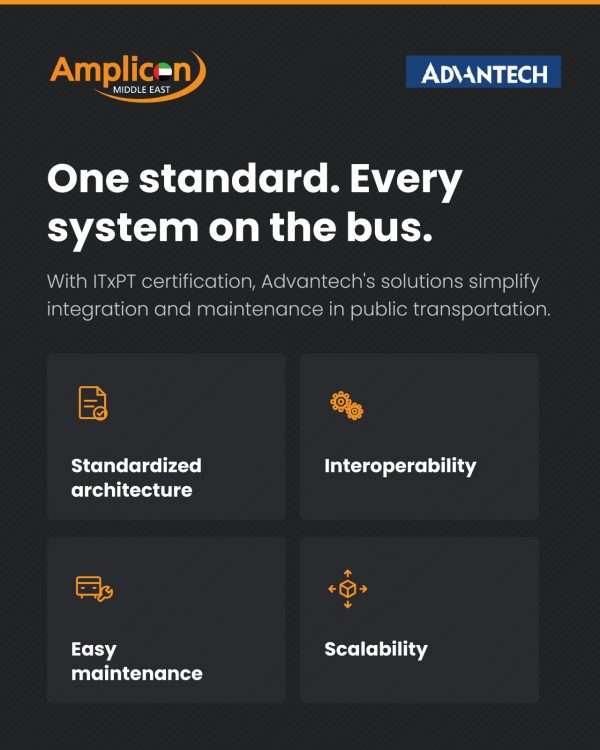
Open standards address these challenges by defining common interfaces that allow hardware and software from different suppliers to interoperate. This is the problem ITxPT is designed to solve in the public transport context.
What is ITxPT?
ITxPT (Information Technology for Public Transport) is an international non-profit association comprising public transport authorities, operators, vehicle manufacturers, and IT software/hardware suppliers. The association defines and promotes open architecture standards for onboard equipment and back-office IT systems.
In practical terms, ITxPT standardises the interfaces and services that onboard IT systems expose to each other like defining how a vehicle computer makes location data available, how a ticketing system accesses the vehicle clock, how a passenger information system retrieves route data, and how all of these services are discoverable across the vehicle network.
ITxPT certification means that a product has been tested and confirmed to implement the ITxPT standard correctly that its interfaces conform to the specification in a way that allows it to interoperate with other certified devices.
Advantech’s ITxPT Certified Transportation Solutions
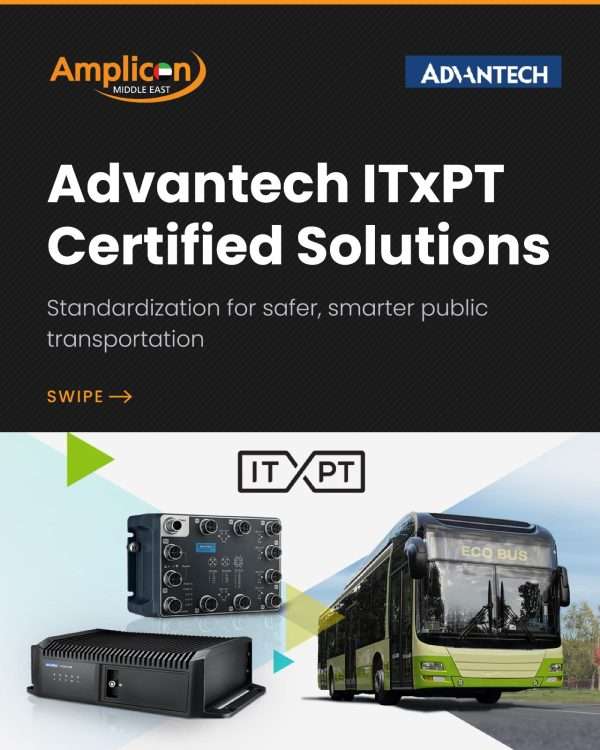
To support transit operators in deploying open, standards-compliant networks, Advantech has achieved official ITxPT certification for two core elements of its transportation portfolio: the TREK-60 vehicle computer and the EKI-9508/9510-ST industrial Ethernet switch series.
Advantech TREK 60
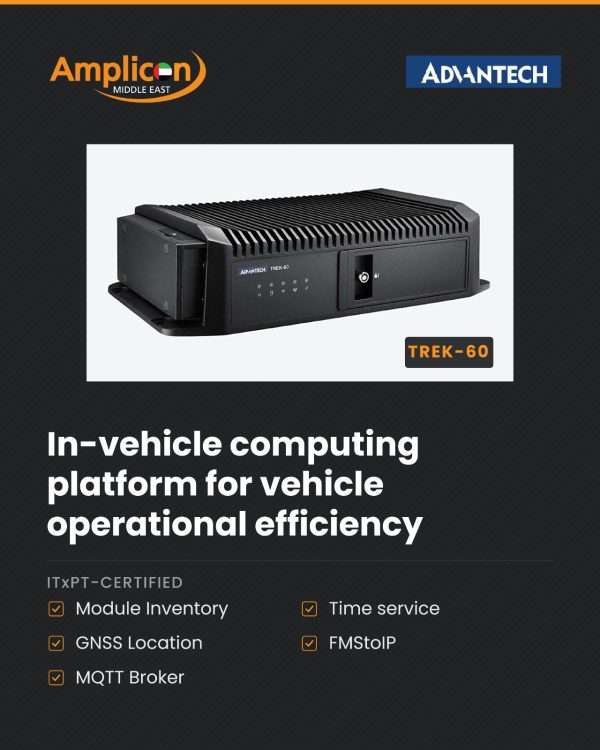
The Advantech TREK-60 is a high-performance, rugged in-vehicle computer designed to serve as the central processing unit for public transport platforms. Operating as an ITxPT device within the vehicle architecture, the TREK-60 consolidates multiple operational workloads onto a single computing engine such as:
Purpose-Built Vehicle Architecture: Engineered specifically for rolling stock and road transit environments, compliant with stringent vehicle power and ignition control standards.
Robust Regulatory Certifications: Holds E-Mark (ECE R10/R118) automotive approvals, ensuring electromagnetic compatibility and compliance with vehicle flame-retardancy standards.
High Processing Capability: Handles concurrent workloads including fleet telematics, driver management software, CAD/AVL positioning, and local video analytics.
Flexible I/O Connectivity: Equips operators with serial, CAN bus, isolation digital I/O, and audio interfaces to connect directly with vehicle engine buses and control systems.
Advantech EKI-9508/9510-ST
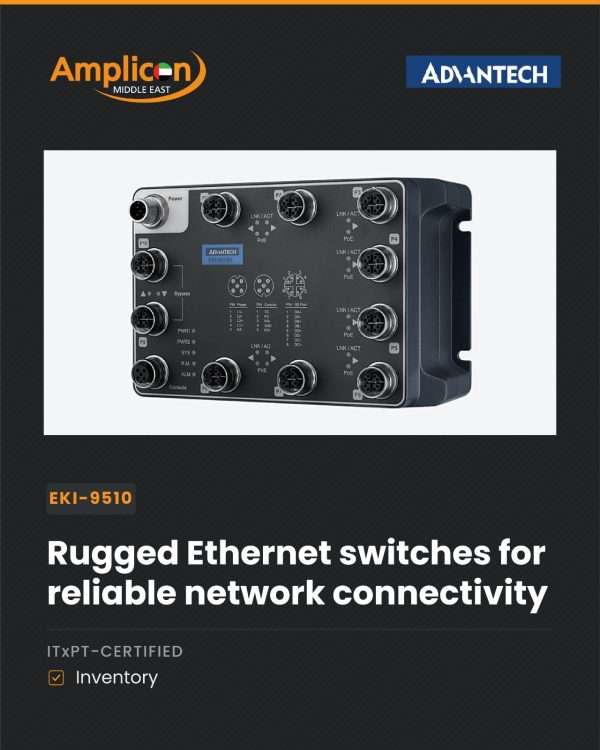
The EKI-9508-ST and EKI-9510-ST are Advantech’s industrial Ethernet switches designed for vehicle networking environments. They use M12 connectors and are built to operate in the harsh electrical and mechanical environment of moving vehicles.
M12 connectors are the established standard for industrial and transportation Ethernet for a specific set of reasons that standard RJ45 connectors cannot address in vehicle environments:
- Vibration resistance: the screw-lock M12 connector stays secured under continuous vibration that would cause push-in RJ45 connections to work loose over time.
- Environmental sealing: M12 connectors provide IP67 protection — fully dust-tight and protected against water immersion which is suitable for the wet, dirty, and humid environments vehicles encounter.
- Compact form factor: the circular M12 housing is smaller than RJ45, important in space-constrained vehicle installations.
- Standards alignment: M12 Ethernet is specified in EN 50155 (railway rolling stock electronics) and IEC 61076-2-101, making it the natural choice for transportation-grade hardware.
The EKI-9508/9510-ST’s ITxPT certification covers Module Inventory enabling ITxPT-compatible management and discovery tools to identify and catalogue the switch within the vehicle’s ITxPT network, consistent with the standardised architecture approach.
Also Read: E2C Trinity: Connecting Industrial Connectivity, Edge Computing and Operational Software
How the TREK 60 and Ethernet Switches Can Fit Together
In a vehicle fitted with both Advantech ITxPT-certified products, the EKI-9508/9510-ST switches and the TREK-60 computer occupy complementary roles in the onboard architecture. The switches provide the physical networking layer while the TREK-60 provides the computing and service layer above it.
A simplified architecture can be shown as:
- Vehicle sensors and systems connect to the EKI-9508/9510-ST switches via M12 Ethernet.
- The switches aggregate this traffic onto the vehicle network and connect to the TREK-60.
- The TREK-60 runs the ITxPT-standardised services like time synchronisation, GNSS data, FMS-to-IP bridging, MQTT messaging that other onboard applications consume.
- Fleet management systems and operational platforms connect either directly or via the vehicle’s cellular or Wi-Fi backhaul to access the data the TREK-60 processes and exposes.
Because both products are ITxPT-certified, other ITxPT-compatible components added to the same vehicle from any ITxPT member supplier can discover and use the services they provide without requiring bespoke integration. This is the practical meaning of the ITxPT interoperability standard in a vehicle architecture context.
ITxPT and Smart Mobility in the Middle East
The Middle East is investing heavily in public transport infrastructure. The UAE, Saudi Arabia, and Qatar are all expanding bus rapid transit systems, metro networks, and fleet electrification programmes at a pace that creates direct demand for the kind of scalable, interoperable technology architecture ITxPT enables. Some examples include:
UAE Smart Transportation
Dubai’s RTA and Abu Dhabi’s Integrated Transport Centre (ITC) are both pursuing connected and intelligent transport initiatives like real-time passenger information, fleet telematics, smart ticketing integration, and data-driven operations management.
These programmes require onboard technology that can evolve as requirements change, integrate across suppliers, and be maintained efficiently across large mixed fleets. ITxPT’s standardised architecture approach directly addresses these operational requirements.
Saudi Arabia and GCC Smart City Programmes
Saudi Vision 2030’s smart city and urban mobility programmes including NEOM’s autonomous mobility work and Riyadh’s metro and bus rapid transit expansion which create significant demand for interoperable transportation technology at scale.
An ITxPT-based architecture is well-suited to large-scale fleet deployments where hardware from multiple procurement cycles must interoperate, and where the ability to swap or upgrade individual components without rebuilding surrounding systems is an operational advantage.
Bus Fleets and Multimodal Infrastructure
Bus fleets across the GCC operated by municipalities, transport authorities, and private operators represent the largest volume application for in-vehicle computing and networking.
As these fleets modernise, the choice between proprietary and standards-based architectures has long-term implications for integration cost, vendor flexibility, and the ability to add capabilities as technology evolves.
Benefits of an Open and Scalable Transport Architecture
An open transportation architecture can provide several practical advantages such as:
Interoperability
Standards based approaches can make it easier to integrate compatible components and systems within a wider transportation architecture.
Scalability
Transportation requirements change over time. An architecture designed with scalability in mind can provide greater flexibility as fleets, applications and connected systems expand.
Maintainability
Large transportation fleets require ongoing maintenance. A more structured technology architecture can help organizations manage equipment and systems throughout their operational lifecycle.
Operational Visibility
Connected computing and networking can provide the infrastructure required for transportation applications that depend on data from onboard equipment.
Why Rugged Industrial Hardware Matters in Transportation
Transportation environments require technology that is appropriate for vehicle based applications. Hardware that functions reliably in controlled indoor environments may not survive the conditions inside an operational transit vehicle over years of daily service like:
Vibration and Shock
Road vehicles and rail rolling stock generate continuous mechanical vibration. Standard commercial computing and networking equipment including the connectors, solder joints, and passive components is not designed for sustained vibration loading.
Transportation-grade hardware is specified and tested to E-mark and EN 50155 standards that include vibration and shock profiles representative of vehicle environments.
Temperature Range
Vehicles experience wide temperature ranges from cold mornings in storage to the heat of a parked cabin in a GCC summer, where interior temperatures can reach well above ambient. Transportation-grade hardware is specified across extended temperature ranges commonly −40°C to +70°C or wider and uses passive cooling designs that do not rely on fans that can fail or accumulate dust.
Power Quality
Vehicle power supplies are not stable. Voltage spikes during engine start, voltage drops under high load, and ignition cycling create electrical conditions that can damage or reset equipment not designed for them.
Transportation-grade hardware includes protection circuitry and wide-range power inputs which the TREK-60’s design accounts for vehicle power characteristics that would disrupt commercial-grade equipment.
Environmental Ingress
Vehicles are exposed to dust, humidity, moisture from rain or cleaning, and in some cases salt air in coastal environments. M12 connectors on the EKI-9508/9510-ST provide IP67 protection specifically because standard RJ45 connectors are not sealed and cannot maintain reliable connections when exposed to these conditions.
Also Read: Advantech EKI-6333BE-4GD: Industrial Wi-Fi 7 for Mission-Critical Connectivity
Why Work with Amplicon Middle East?
Amplicon Middle East is an authorised Advantech distribution partner supplying transportation networking and computing solutions across the UAE, Saudi Arabia, Qatar, and the wider GCC. For a transportation project evaluating Advantech’s ITxPT-certified solutions, our team offers:
- Product selection and technical advisory: Helping evaluate the TREK-60 and EKI-9508/9510-ST against your specific vehicle type, application requirements, and integration environment
- Transportation networking expertise: Understanding of vehicle networking architectures, industrial Ethernet standards, and onboard computing integration requirements
- ITxPT architecture guidance: Advising on how Advantech’s certified solutions fit within an ITxPT-oriented vehicle architecture alongside other certified components
- Regional stock and fast fulfilment: Inventory held in Dubai for UAE delivery and GCC regional supply without international lead times
- System integration consultation: Supporting integration of Advantech hardware with fleet management platforms, vehicle telematics systems, and operational infrastructure
FAQ: ITxPT-Certified Transportation Technology
What is ITxPT?
ITxPT is an initiative focused on open and interoperable IT architectures for public transport. It specifies how onboard IT systems like computers, networking equipment, applications, and services communicate with each other, enabling components from different suppliers to interoperate on the same vehicle without bespoke integration.
What does ITxPT certification mean?
ITxPT certification means a product has been tested and confirmed to implement the ITxPT standard’s interfaces correctly that it exposes the standardised services defined by ITxPT in a way that allows it to interoperate with other ITxPT-certified devices on a vehicle network.
What is an ITxPT certified device?
An ITxPT-certified device is a hardware or software product that has passed ITxPT’s conformance testing and been confirmed to implement the ITxPT standard’s specified interfaces.
What is the Advantech TREK 60?
The TREK 60 is a rugged in vehicle computer and one of Advantech’s ITxPT certified transportation solutions.
What is the Advantech EKI 9508/9510 ST?
The EKI 9508/9510 ST is an industrial M12 Ethernet switch included among Advantech’s ITxPT certified solutions.
Why are M12 Ethernet switches used in transportation?
M12 Ethernet connectivity is designed for applications where robust physical network connections are important. The EKI 9508/9510 ST is positioned by Advantech as an industrial M12 Ethernet switch for transportation applications.
How can ITxPT support smart transportation?
ITxPT enables smarter transportation by providing the open integration foundation that connected vehicle services require. Passenger information systems, fleet telematics, smart ticketing, and real-time operations management all depend on reliable data flows between onboard systems.
Is ITxPT relevant to public transport projects in the Middle East?=
ITxPT can be considered when developing connected public transport architectures in the Middle East. Its relevance to a specific project depends on the operator’s technical requirements, system architecture and procurement specifications.
Planning a connected public transport or intelligent mobility project in the UAE or GCC?

Contact Amplicon Middle East to discuss Advantech’s ITxPT-certified transportation solutions including the TREK-60 rugged in-vehicle computer and EKI-9508/9510-ST industrial M12 Ethernet switches.
Our team can advise on product selection, vehicle network architecture, and integration with fleet management and operational platforms.