
Physical AI, which is the AI that perceives, decides, and acts in the real world through sensors, cameras, and autonomous systems demands compute that is powerful, compact, and built for environments where standard IT hardware simply fails. Oil platforms, port craneways, factory floors, and autonomous vehicles don’t have climate-controlled server rooms. They have heat, vibration, dust, and zero tolerance for downtime.
ASUS has engineered a new generation of rugged edge AI platforms specifically for these conditions. Showcased at COMPUTEX 2026 and now available through Amplicon Middle East, the latest ASUS edge AI systems bring military-grade durability and data-centre-class AI performance to the most demanding industrial deployments in the region.
Accelerating Physical AI with Next-Generation Edge Supercomputing in the GCC
Physical AI requires computing hardware capable of executing large-scale generative AI models and multi-sensor fusion algorithms right on the factory floor or aboard mobile machinery. Standard office PCs and commercial rack servers cannot survive the extreme vibration, dust, and temperature fluctuations of industrial sites.
Heavyweight Performance: The ASUS PE3000N Series in the UAE

To meet the demands of advanced generative AI pipelines and autonomous robotics, ASUS introduced the PE3000N Series . Designed as a next-generation edge AI supercomputer, the PE3000N is powered by NVIDIA® Jetson T5000™/T4000™ system-on-modules, delivering an extraordinary computing capacity of up to 2,070 FP4 TFLOPS.
Key engineering features include:
Unrivaled AI Throughput: Supports local generative intelligence, high-throughput transformer models, and real-time vision-language models at the physical edge.
Flexible Modular Expansion: The modular chassis design including the PE3001N variant with a secondary I/O stack which allows engineers to customize interface configurations for complex sensor setups.
Industrial Power Resilience: Features a wide 12-60V DC power input range to accommodate voltage fluctuations across diverse mobile robotics platforms and factory power grids.
Built to Withstand Industrial Conditions: MIL-STD-810H validation covers shock, vibration, humidity, altitude, and temperature extremes which is the full spectrum of conditions found in GCC industrial sites. The fanless design eliminates moving parts and dust ingestion.
Machine Vision & Modular Control: Scalable Edge Deployment for Middle Eastern Manufacting
In high-speed assembly, automated optical inspection (AOI), and multi-camera machine vision, industrial facilities require compact systems that scale easily from isolated workstations to enterprise server racks.
The ASUS RUC-2000-Series in the UAE
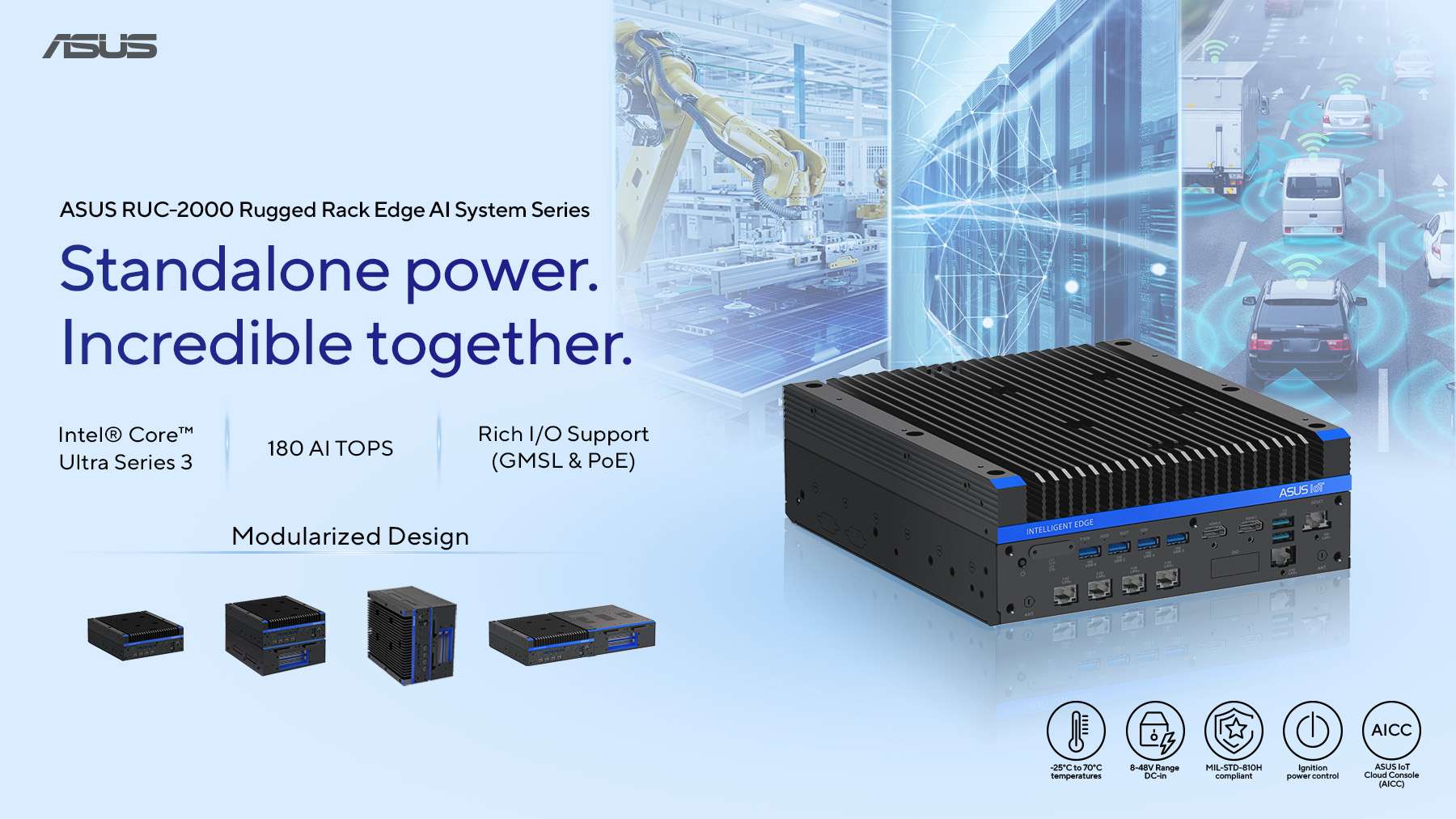
Unveiled at COMPUTEX 2026, the ASUS RUC-2000-series bridges the gap between compact edge devices and rackmount IT infrastructure. Powered by the Intel® Core™ Ultra Series 3 processor, the system delivers up to 180 AI TOPS of local inference performance.
Designed specifically for constrained industrial spaces, the RUC-2000 series features a 2U half-rack fanless modular design that scales seamlessly into a standard 19-inch rack enclosure.
By supporting up to 8 x GMSL2 camera feeds and high-bandwidth 10GbE + 5 x 2.5GbE networking, the RUC-2000 empowers manufacturers to run high-frame-rate machine vision algorithms and intelligent video analytics without network latency bottlenecks.
Physical AI in Action: Three Real-World Deployments
Here are three live deployments showing what Physical AI looks like when the hardware is right.
1. Autonomous Sightseeing Shuttles: Smart Tourism at the Edge
A scenic tourism operator deployed the ASUS PE1103N built on NVIDIA Jetson Orin (up to 157 TOPS) as the onboard AI core for autonomous sightseeing shuttles. The platform handles millisecond-level time synchronisation and real-time multi-sensor fusion across cameras, LiDAR, radar, and IMU simultaneously.
The result: smoother obstacle avoidance, steadier navigation on inclines, and safer operation in mixed pedestrian/vehicle environments. The PE1103N supports up to eight GMSL2 cameras and operates from –20°C to 60°C in a fanless enclosure performing in mountain terrain and summer heat without complaint.
2. Maritime Security: Real-Time Vessel Detection Without AIS
A client deployed the ASUS PE1100N at a port facility to enable real-time vessel detection, classification, and tracking without relying on AIS (Automatic Identification System), which can be spoofed or disabled.
Running on NVIDIA Jetson Orin (up to 100 TOPS), the PE1100N processes up to four simultaneous camera streams locally with low latency. The compact, fanless aluminium chassis handles –20°C to +50°C operation with anti-vibration design and 12–24V DC input which is purpose-built for harsh, off-grid port environments.
3. Predictive Maintenance: Stopping Failures Before They Happen
iOmniscient deployed the ASUS PE3100G to power a predictive maintenance solution for industrial equipment. By integrating cameras and industrial sensors, the system detects early warning signs of failure before they cascade into unplanned downtime.
When anomalies are detected, the system autonomously triggers predefined safety responses. The PE3100G handles AI inference, image processing, and low-latency decision-making entirely at the edge, where the equipment is.
Deploy ASUS Rugged Edge AI Through Amplicon Middle East
Amplicon Middle East supplies ASUS edge AI systems across the UAE, Saudi Arabia, Qatar, and the wider GCC. Our engineering team has hands-on experience integrating these platforms into industrial environments.
Whether you’re building a new machine vision line, upgrading field surveillance at a port, retrofitting predictive maintenance into an existing facility, or designing an autonomous platform from the ground up, we can help you select the right ASUS edge AI system for the workload and get it deployed.
Contact Amplicon Middle East to discuss your edge AI requirements.
FAQ
What is Physical AI in manufacturing?
Physical AI refers to AI models such as computer vision, reinforcement learning, and generative AI that operate directly within physical systems like industrial robots, conveyor networks, and autonomous vehicles to perceive their environment and execute real-time, physical actions without relying on human intervention or cloud compute loops.
Why choose GMSL2 cameras over standard cameras for industrial AI?
GMSL2 (Gigabit Multimedia Serial Link 2) cameras are specifically engineered for high-speed, harsh environments. They offer uncompressed, ultra-low latency video transmission over long cable lengths up to 15 meters with high electromagnetic immunity and robust lockable connectors, making them ideal for multi-camera robotics and machine vision.
What is the difference between physical AI and agentic AI?
Agentic AI operates in the digital realm, functioning as a proactive software assistant that can plan, make decisions, and execute multi-step workflows across applications. Physical AI, often called embodied AI, operates in the material world, using sensors and actuators to perceive, manipulate, and navigate real-world environments.
How does edge AI enable predictive maintenance without cloud dependency?
Edge AI systems, such as those powered by the ASUS PE3100G, run machine learning models locally on device processors. By analyzing acoustic, thermal, and vibration sensor feeds in real time at the machine level, the system detects micro-anomalies instantly and initiates corrective actions without transferring sensitive telemetry data over external cloud networks.
What temperatures can ASUS rugged edge platforms endure?
ASUS rugged edge systems are thermally engineered for extreme environments. Models like the PE1103N support wide-temperature operations from –20°C to +60°C , ensuring stable continuous performance inside hot engine bays, outdoor port facilities, or unconditioned factory floors.


